Day By Day

Sunday, December 11, 2005

Omar at Iraq the Model reports from Baghdad on recent developments in the election campaigns.

Abdulaziz al-Hakeem's UIA, big winners in the last round of elections, seem to be nervous. They are already warning of possible voter fraud, which sounds like they are laying the groundwork for a post-election court challenge.

By contrast, Allawi is sounding confident, despite well-publicized recent protests against him.
It is noticed that so far, Allawi is the only candidate who is leading a professional campaign, and I mean really professional; the TV ads, the posters and the signs are very well produced and the words are carefully chosen and they’re attracting good attention among the people here. [Baghdad]
The Islamic Party, part of the National Accord Front, is also sounding worried, claiming that the imposition of martial law in some areas will bias the vote.

Finally, and most interesting, Major Shiite clerics, led by Ayatollah Sistani, have made it quite clear that they are not endorsing any electoral slate. They denounced rumors to the contrary.

Read it here.

All in all it doesn't sound that much different from the rhetorical posturing that takes place in the runup to our elections here..., except for the gunfire of course.

And there's a lot of that. "A Citizen of Mosul" reports on the pre-election crackdown there.
The situation in the city of Mosul is very stressful. The US convoys wandering through out the city day and night. The police cars full of policemen holding gun aiming at the pedestrians and firing their guns at any car which fail to stop or approaching the convoy.

From the other side there were explosions every where, masked gunmen attacking the US soldiers and the Iraqi police. The roads are blocked by either a concrete blocks or barbed wires making the moving in the city streets very difficult and dangerous.

In Mosul there are five bridges across the river Tigris joining the two sides of the city together, during the last few days, all the bridges are either blocked completely or there were a check points at the beginning of the bridges to search all the cars which attempt to cross the bridge. This make the movement across the bridge very very difficult.
Read it here.

Four more days to go..., stay tuned.

Now This is Cool... The Ice Cometh

NOAA has a neat site showing the advance of ice and snow over the past month. Watching it you can almost believe in a coming ice age.

Check it out here.

Mugabe's End Game


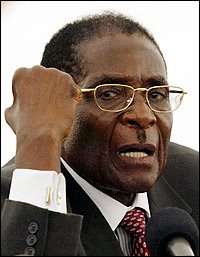
Mad Bobby Mugabe is signalling his intention to completely eradicate Zimbabwe's white farmer class. M&C News reports:

Harare - Zimbabwean President Robert Mugabe lashed out Saturday at the few remaining white farmers in Zimbabwe at the end of a three-day ruling party conference.

Mugabe said Zimbabwe had to look after its own people's interests first before those of white people.

'We still have white Rhodesian farmers resisting land reform often supported by some of us in the party and government,' he said.

Addressing thousands of members of his Zimbabwe African National Union - Patriotic Front (ZANU-PF) at the conference in Esigodini, southern Zimbabwe, Mugabe said: 'We do not defend Rhodesian settler interests against those of our people.

Similar pronouncements have accompanied earlier racist purges in which whites were killed or driven off their lands which were then turned over to Mugabe's cronies. Only about 300 white farmers remain in Zimbabwe. Twelve were killed and another twenty thrown off their lands by armed thugs in recent weeks. Much more of this and white Zimbabwe will cease to exist.

Read it here.

Saturday, December 10, 2005

Condi Tells It Like It Is!


In case there are still some of you out there who haven't gotten the point, Condi explains.

From the WaPo: [It's so good I'm quoting it in full]

By Condoleezza Rice
Sunday, December 11, 2005; B07

Soon after arriving at the State Department earlier this year, I hung a portrait of Dean Acheson in my office. Over half a century ago, as America sought to create the world anew in the aftermath of World War II, Acheson sat in the office that I now occupy. And I hung his picture where I did for a reason.

Like Acheson and his contemporaries, we live in an extraordinary time -- one in which the terrain of international politics is shifting beneath our feet and the pace of historical change outstrips even the most vivid imagination. My predecessor's portrait is a reminder that in times of unprecedented change, the traditional diplomacy of crisis management is insufficient. Instead, we must transcend the doctrines and debates of the past and transform volatile status quos that no longer serve our interests. What is needed is a realistic statecraft for a transformed world.

President Bush outlined the vision for it in his second inaugural address: "It is the policy of the United States to seek and support the growth of democratic movements and institutions in every nation and culture, with the ultimate goal of ending tyranny in our world." This is admittedly a bold course of action, but it is consistent with the proud tradition of American foreign policy, especially such recent presidents as Harry Truman and Ronald Reagan. Most important: Like the ambitious policies of Truman and Reagan, our statecraft will succeed not simply because it is optimistic and idealistic but also because it is premised on sound strategic logic and a proper understanding of the new realities we face.

Our statecraft today recognizes that centuries of international practice and precedent have been overturned in the past 15 years. Consider one example: For the first time since the Peace of Westphalia in 1648, the prospect of violent conflict between great powers is becoming ever more unthinkable. Major states are increasingly competing in peace, not preparing for war. To advance this remarkable trend, the United States is transforming our partnerships with nations such as Japan and Russia, with the European Union, and especially with China and India. Together we are building a more lasting and durable form of global stability: a balance of power that favors freedom.

This unprecedented change has supported others. Since its creation more than 350 years ago, the modern state system has always rested on the concept of sovereignty. It was assumed that states were the primary international actors and that every state was able and willing to address the threats emerging from its territory. Today, however, we have seen that these assumptions no longer hold, and as a result the greatest threats to our security are defined more by the dynamics within weak and failing states than by the borders between strong and aggressive ones.

The phenomenon of weak and failing states is not new, but the danger they now pose is unparalleled. When people, goods and information traverse the globe as fast as they do today, transnational threats such as disease or terrorism can inflict damage comparable to the standing armies of nation-states. Absent responsible state authority, threats that would and should be contained within a country's borders can now melt into the world and wreak untold havoc. Weak and failing states serve as global pathways that facilitate the spread of pandemics, the movement of criminals and terrorists, and the proliferation of the world's most dangerous weapons.

Our experience of this new world leads us to conclude that the fundamental character of regimes matters more today than the international distribution of power. Insisting otherwise is imprudent and impractical. The goal of our statecraft is to help create a world of democratic, well-governed states that can meet the needs of their citizens and conduct themselves responsibly in the international system. Attempting to draw neat, clean lines between our security interests and our democratic ideals does not reflect the reality of today's world. Supporting the growth of democratic institutions in all nations is not some moralistic flight of fancy; it is the only realistic response to our present challenges.

In one region of the world, however, the problems emerging from the character of regimes are more urgent than in any other. The "freedom deficit" in the broader Middle East provides fertile ground for the growth of an ideology of hatred so vicious and virulent that it leads people to strap suicide bombs to their bodies and fly airplanes into buildings. When the citizens of this region cannot advance their interests and redress their grievances through an open political process, they retreat hopelessly into the shadows to be preyed upon by evil men with violent designs. In these societies, it is illusory to encourage economic reform by itself and hope that the freedom deficit will work itself out over time.

Though the broader Middle East has no history of democracy, this is not an excuse for doing nothing. If every action required a precedent, there would be no firsts. We are confident that democracy will succeed in this region not simply because we have faith in our principles but because the basic human longing for liberty and democratic rights has transformed our world. Dogmatic cynics and cultural determinists were once certain that "Asian values," or Latin culture, or Slavic despotism, or African tribalism would each render democracy impossible. But they were wrong, and our statecraft must now be guided by the undeniable truth that democracy is the only assurance of lasting peace and security between states, because it is the only guarantee of freedom and justice within states.

Implicit within the goals of our statecraft are the limits of our power and the reasons for our humility. Unlike tyranny, democracy by its very nature is never imposed. Citizens of conviction must choose it -- and not just in one election. The work of democracy is a daily process to build the institutions of democracy: the rule of law, an independent judiciary, free media and property rights, among others. The United States cannot manufacture these outcomes, but we can and must create opportunities for individuals to assume ownership of their own lives and nations. Our power gains its greatest legitimacy when we support the natural right of all people, even those who disagree with us, to govern themselves in liberty.

The statecraft that America is called to practice in today's world is ambitious, even revolutionary, but it is not imprudent. A conservative temperament will rightly be skeptical of any policy that embraces change and rejects the status quo, but that is not an argument against the merits of such a policy. As Truman once said, "The world is not static, and the status quo is not sacred." In times of extraordinary change such as ours, when the costs of inaction outweigh the risks of action, doing nothing is not an option. If the school of thought called "realism" is to be truly realistic, it must recognize that stability without democracy will prove to be false stability, and that fear of change is not a positive prescription for policy.

After all, who truly believes, after the attacks of Sept. 11, 2001, that the status quo in the Middle East was stable, beneficial and worth defending? How could it have been prudent to preserve the state of affairs in a region that was incubating and exporting terrorism; where the proliferation of deadly weapons was getting worse, not better; where authoritarian regimes were projecting their failures onto innocent nations and peoples; where Lebanon suffered under the boot heel of Syrian occupation; where a corrupt Palestinian Authority cared more for its own preservation than for its people's aspirations; and where a tyrant such as Saddam Hussein was free to slaughter his citizens, destabilize his neighbors and undermine the hope of peace between Israelis and Palestinians? It is sheer fantasy to assume that the Middle East was just peachy before America disrupted its alleged stability.

Had we believed this, and had we done nothing, consider all that we would have missed in just the past year: A Lebanon that is free of foreign occupation and advancing democratic reform. A Palestinian Authority run by an elected leader who openly calls for peace with Israel. An Egypt that has amended its constitution to hold multiparty elections. A Kuwait where women are now full citizens. And, of course, an Iraq that in the face of a horrific insurgency has held historic elections, drafted and ratified a new national charter, and will go to the polls again in coming days to elect a new constitutional government.

At this time last year, such unprecedented progress seemed impossible. One day it will all seem to have been inevitable. This is the nature of extraordinary times, which Acheson understood well and described perfectly in his memoirs. "The significance of events," he wrote, "was shrouded in ambiguity. We groped after interpretations of them, sometimes reversed lines of action based on earlier views, and hesitated long before grasping what now seems obvious." When Acheson left office in 1953, he could not know the fate of the policies he helped to create. He certainly could never have predicted that nearly four decades later, war between Europe's major powers would be unthinkable, or that America and the world would be harvesting the fruits of his good decisions and managing the collapse of communism. But because leaders such as Acheson steered American statecraft with our principles when precedents for action were lacking, because they dealt with their world as it was but never believed they were powerless to change it for the better, the promise of democratic peace is now a reality in all of Europe and in much of Asia.

When I walk past Acheson's portrait upon departing my office for the last time, no one will be able to know the full scope of what our statecraft has achieved. But I have an abiding confidence that we will have laid a firm foundation of principle -- a foundation on which future generations will realize our nation's vision of a fully free, democratic and peaceful world. [emphases mine]

Nuff sed!

Go Condi..., go Condi..., go Condi!!!!


More Condi


And here's Condi in Rumania, being welcomed by Nadia Comaneci and her gang of gymnasts. While there she signed a pact establishing the first US military base in Rumania. Way to go gal!

For more on Condi's excellent adventures in Eastern Europe check out Gateway Pundit here.

Condi in Ukraine


The French and German elites might not be impressed with Condi these days, but Ukraine sure is. Here she is talking with students in Kiev and obviously enjoying the experience.

Bloggery in the Cross Street Market


"She Who Must Not Be Named" asked me to walk with her down into the wilds of Federal Hill today, then left me waiting while she and some friends exercised over at "Curves" [no men allowed]. So I had some time to kill, why not blog? The chic coffee shops in the area were all filled to the gills with lunch-time crowds so I wandered into the Cross Street Market. To my surprise I found that one of my favorite snack and sandwich stands, Big Jim's Deli, now had WiFi. They even had a small table set aside for internet access under the sign "Big Jim's Executive Dinning Room" [snicker]. It's a great place, run by nice people, and it's located right in the middle of one of the busiest places in town. I love the atmosphere at the Market. It's one place where everyone, and I mean everyone, comes, and now I can sit there surrounded by subdued chaos and blog to my heart's content.

It wasn't long ago that you had to go to a bookstore or coffee shop to engage in public bloggery. Now that Big Jim's in the game, can Steve's Lunch [also in the Market] be far behind?

The Etiology of Terrorism

Walter Laqueur reviews two attempts by psychologists to discover the roots of terrorism in today's Times. [here]. Neither is very successful. The phenomenon is just too complex to be contained with any accepted theoretical constructs. However, both note an important common element -- gang culture. He writes:
The emphasis on the role of the gang or clique is very important and has been overlooked in the past – except perhaps by those focusing on street crime.
Now I'm not a psychologist, but one thing leaps out at me from Laqueur's discussion. The clique mentality described by both authors is quite similar to explanations given by soldiers in combat when discussing their acts of heroism. There is also an eerie resemblance to accounts of extraordinary efforts made by athletes in the heat of competition. Not letting down the guys seems to be a common factor in all of these and an understanding of terrorism might lie more in the realm of small group dynamics than in any broader socio/economic, political, or psychological framework.

I would fault Laqueur on one point. He seems to indicate that the gang phenomenon is a recent development spawned by the anomie of a world in which traditional categories of identification are crumbling. My own work with nineteenth-century migrant communities suggests that the problem has been around for much longer than he appreciates.

Friday, December 09, 2005

Luz [Luce] Potter Has Passed Away


She didn't make many films and only had bit parts in them, but she provided me with one of the scariest images of my childhood, one that I will carry to my grave.

The Telegraph reports:
Luz Potter, who has died at Rancho Mirage, Palm Springs, aged 90, enjoyed roles in two cult science fiction films of the 1950s: Invaders from Mars and The Incredible Shrinking Man, and was one of the last surviving Munchkins from The Wizard of Oz.
Read it here.

Luz Potter, rest in peace.

Another Hero Picture


Last time I blogged about my nephew Tom, currently deployed in Iraq for his second tour, the only pictures I had were two years old (from his first time over there). Here's an update, a picture of him with his oldest two children. They observed an early Christmas because he had to leave. He's over there now and so far everything is going well. Our hopes and prayers are with him.

UPDATE:

Not shown in the picture is Tom's wife, Wendy (who took the picture), and Reaghan, who probably was not born yet when the picture was taken.

Zimbabwe Update -- The UN is "Puzzled" by the "Meltdown"

BBC reports:
Zimbabwe is in "meltdown" says United Nations humanitarian chief Jan Egeland following a visit to the country.

He also said President Robert Mugabe's rejection of tents for hundreds of thousands of people evicted and made homeless this year is "puzzling".

There's no puzzle here. The country is governed by a madman. And the "international community" is incapable of doing anything about it.

Here are a few specifics:

"The situation is very serious in Zimbabwe when life expectancy goes from more than 60 years to just over 30 years in a 15-year span - it's a meltdown, it's not just a crisis, it's a meltdown," Mr Egeland told the BBC in Johannesburg, immediately after his four-day trip to Zimbabwe.

He pointed to "the Aids pandemic, the food insecurity, the total collapse in social services". [emphases mine]

And as for the government's slum clearance program that has rendered 700,000 people homeless:

"The eviction campaign seems to me wholly irrational in all of its aspects - you lowered the standard of living rather than increasing it."
And to top everything, Mad Bobby Mugabe refused an offer of tents to be used as termporary shelters for the homeless, saying "Zimbabweans are not tent people." He demanded that the UN instead build permanent housing for the victims of his policies.

It's hard to say which is the greater madness, Mugabe's atrocities or the UN's refusal to do anything meaningful about them.

Read about it here.


Now this is Disturbing...

Carol Gould reports on the jihadist/left alliance in Britain. She writes:
Just before going back to the USA after five months in the UK I attended the ‘Global Peace and Unity’ Conference at London’s Excel Centre presented by the new Islam Channel and sponsored by Emirates Airlines, Western Union (hmm??) and the Metropolitan Police.

It was advertised as a diverse event to which non-Muslims were invited and the impression one got from the website was of a celebration of Middle Eastern culture, food, music and children’s activities in a London milieu.

To my utter horror -- and I should have written this report two days ago but my physical and emotional shock have rendered me nearly inert -- it was a seven-hour call to Jihad by a succession of ranting and shouting rabble-rousers.
Read the whole thing here.

Pre-election polls in Iraq

Omar at Iraq the Model looks at the polls.

The results of a public opinion pool conducted in Babil province showed some interesting findings; the poll conducted by al-Mada research institute interviewed 460 men and women in a random sample technique from both the urban and rural parts of the province.

When asked if they were going to vote or not, 96.7% answered with “yes” while in only 3.3% of the cases the answer came as “no”.

When asked which list they’re going to vote for, 41.6% said they’ll be voting for the United Iraqi Alliance, second came Allawi’s “731 list” with 24.6% while all the rest of lists shared 15.5% of the votes in the poll.

The remaining 13.8% said they hadn’t made up their minds yet, something not unusual if we know most people know very little about the lists’ they’re supposed to chose from.


This poll showed that 77% of the interviewed people knew only the head of the list (24.8%) or a few more members of their favorite list (52.2%).
Read it here.

It's that last figure that interests me. Almost none of the candidates are known to the voters. This is what happens when parties are created from the top down.

Flores Hobbit Update


From Discover magazine [via John Hawks]
Flores Man Denied Status As New Species
Poor Flores Man just can't rest in peace. All year a controversy has raged about whether the bones found in 2003 on the remote Indonesian island of Flores represent a new species. Australian paleoanthropologist Peter Brown insists the skeleton is a new type of human who should be called Homo floresiensis. Others say he's [sic] simply a pygmy, five feet tall, who had microcephaly, a condition that results in a small, oddly shaped skull.
That's why Robert Eckhardt, a paleoanthropologist at Pennsylvania State University, and a team have intently analyzed the 18,000-year-old bones. The group's research papers, undergoing peer review, are unequivocal. "Homo floresiensis," says Eckhardt, "is not a valid new human species."
Brown is dismissive. "Robert Eckhardt is thick as a plank," he says....
I've met Eckhardt, he's definitely not thick -- maybe a bit plankish, but not thick. I love the playground level of modern scientific discourse.

Sorry, I Just Don't Get It


No, I don't remember where I was when John Lennon died. But I do remember one incident that took place shortly afterward. I went to visit a friend, and found him sitting in his living room with several other guys listening to the radio which was playing beatles tunes back to back. Nobody spoke, they just sat there glumly. I said, "What's the big deal? He was just a rock star."

Remember that scene in "Invasion of the Body Snatchers" when the pod people realize that Kevin McCarthy is not one of them. Their heads swivel as one toward him, eyes filled with hate, before they start pointing and screeching. Well, it was like that. I realized that I had made some irredeemable faux pas. I made some excuse and left. Their stares followed me out the door.

Things were never quite the same with them after that. A conceptual and cultural chasm had gaped wide, never to be closed. Lennon was vitally important to them, for reasons I could never fathom. There was some strange complex of ideas and symbols in their lives and minds I could not penetrate. To me John Lennon was just another rocker and his passing was a matter of little consequence. To them, it was the end of an era.

Now, twenty-five years later the anniversary of Lennon's death has been observed with wall to wall media coverage. Apparently he still means something to enough people to merit the extravagant grief on display, but I have to admit that I still don't get it. After all, it's not like he was Mel Torme or someone like that.

I suppose I could take this opportunity to say something about generation gaps, or the impact of the media on boomer consciousness, or the iconography of an emergent consumer culture, but I won't because..., well..., I just don't get it, just as I will never "get" the whole Princess Di thing.

Thursday, December 08, 2005

The Collapse of Iron City?


I may have been born a couple of blocks from the Rolling Rock brewery, but I grew up drinking Iron City. Now comes news that the Pittsburgh Brewing Company, maker of Iron City Beer [and Olde Frothingslosh, the "A whale of an ale for the pale stale male"; the only beer with foam on the bottom; the only beer that glows in the dark, etc.] has declared bankruptcy.

Is this the end of Fatima Yechburgh (Miss Olde Frothingslosh, pictured on the cans above)? Apparently not. This seems to be just a ploy on the part of management to get out from under pension fund obligations.

Read about it here.

Oh yes, regarding Olde Frothingslosh, read about it here and here.

This really brings back my childhood when I used to listen every weekday to Cordic & Co. on KittyKat (KDKA) Radio.

Bumping Bush

The Times/CBS Poll results show a 5% uptick in Bush's job approval ratings. CBS calls it a "bump" but the NYT sees it as a "marked improvement."

"Mystery Pollster" does a quick, expert overview. What jumps out of the stats is the importance of the Iraq war. Of those who disapprove of Bush a majority cite the war as the reason. No other factor comes close. The Democrat attempts to portray him as dishonest seem to have failed. Few people, even among the President's opponents, accept that characterization of him. Also of interest is the fact that Bush's greatest gains have been among men, independents, and 18-29 year olds.

The Times presentation of the poll data is here.

CBS breakdown is here.

Mystery Pollster is here.

Auto Porn

Toby, the Bilious Young Fogey, shows us the Lamborghini SUV concept car. Check it out here. While you are there check around his site. Lots of new stuff there. He's been on bloggery overdrive -- more than fifty posts in two days, I hear.

Balls and Bats -- The Latest "Scientific" Finding -- Big Brain Equals Small Testes (in bats)


Now this explains a lot.

At last, "scientific" confirmation of what every academic knows, but is afraid to admit.
From the New Scientist:

Big brain means small testes, finds bat study

The brainier male bats are, the smaller their testicles, according to a new study. Researchers suggest the correlation exists because both organs require a lot of energy to grow and maintain, leading individual species to find the optimum balance.

The analysis of 334 species of bat found that in species where the females were promiscuous, the males had evolved larger testes but had relatively small brains. In species, where the females were monogamous, the situation was reversed. Male fidelity appeared to have no influence over testes or brain size.

Read the whole thing here.

Cat Bloggery


I mentioned feral cats in an earlier post. Here are a couple of them that wandered down into our driveway just a few weeks ago. When I went outside to try to get a good picture of them, they fled into the deep woods. Maybe it's for the best. During the migration season lots of hungry eagles fly over our place and these guys are just about snack size.

Faction fighting in Kurdistan

Omar at Iraq the Model is reporting on faction violence in the runup to the elections in Iraq. He makes an interesting point. Vote fraud is more likely to ensue in the peripheral ethnically homogeneous regions than in the ethnically-mixed center of the country. Read his commentary here.

The National Debt Clock

This is for one of my inside-the-beltway [barely] correspondents. The U.S. National Debt Clock. Here you can see the total debt, the per capita debt, and links to articles about the debt.

For fiscal conservatives this is a must see site. Check it out here.

As I write the debt stands at $8,127,913,753,700.76. It is increasing at a rate of about $2.83 billion/day. On a per capita basis it represents a debt of $27,282.31 for each and every inhabitant of the country.

Have a nice day.

Egyptian Election Deaths


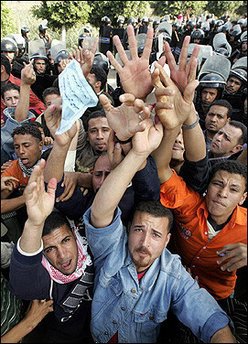
Egyptian troops opened fire yesterday on citizens attempting to vote on the last day of elections. "Realists" will emphasize the civil disturbances that provoked the killing and say that this is simply Islamist radicals trying to gain international publicity, and to an extent they are right. But it is the autocratic government that the US has propped up for decades that has made Islamist radicalism so widespread in Egypt. The larger point is that the drive for democracy that has emerged in the Middle East in recent years is a real phenomenon that will not easily be contained, by us, by the corrupt despotic regimes, or even by the Islamists.

Gateway Pundit is all over this story [here]. He is absolutely right to note that this completely discredits the argument, so often heard from war critics, that Arabs are "not ready for" democracy. As Gateway points out, people are literally dying to vote.

Check out Kirk Sowell's Publius' roundup here.

And, by all means check out the Sandmonkey post here. [good pics]

Morning at the Metropolitan


Blogging this morning from the Metropolitan on South Charles Street, just a few blocks from the Harbor. It's a nice neighborhood place. Good coffee, pleasant and efficient service, FREE Wi-Fi, and no toddlers -- I think I've definitely changed my preferences. I'll still go to the old place when the guys meet there, but for reading, writing and contemplation [and now blogging] this is the place for me. The only drawback is the music [urban funky sorta stuff], but as I get older I find that to be the case almost everywhere. No matter. With my I-pod and Bose headphones I can isolate myself anywhere. Right now as I sip my coffee I'm listening to Jascha Heifetz playing Beethoven's violin concerto. Pure bliss!

Bush and Lincoln

So far I have resisted drawing any analogies between President Bush's current situation and that of Abraham Lincoln during the Civil War, although in some respects the the similarities are striking.

Usually such comparisons are superficial and misleading, but occasionally in the right hands they can be instructive. Such is the case with William B. Stuntz' recent article in the New Republic.

He writes:

In 1861 Abraham Lincoln led what was left of his country to war to restore "the Union as it was," to use the popular phrase of the time. Free navigation of the Mississippi River, the right to collect customs duties in Southern ports, the status of a pair of coastal forts in South Carolina and Florida--these were the issues over which young American men got down to the business of killing one another that sad summer.

It was all a pipe dream. "The Union as it was" was gone, forever. Events proved William Tecumseh Sherman--the prophet of that war--right, and everyone else wrong: An ocean of blood would be required to reunite the United States, and once that blood was spilled, the country over which James Buchanan had presided was as dead as the soldiers whose corpses littered the battlefields of Shiloh and Gettysburg, Antietam and Cold Harbor.

But there was a much bigger, much better, and above all much nobler dream waiting in the wings: "that this nation, under God, shall have a new birth of freedom" (to use Lincoln's own words)--that the chains of four million slaves might be shattered forever, that freedom and democracy might prevail against tyranny and aristocracy in a world still full of tyrants and aristocrats.
...
Thankfully, Lincoln saw to it that the war's purpose changed. George W. Bush has changed the purpose of his war too, though the change seems more the product of our enemies' choices than of Bush's design. By prolonging the war, Zarqawi and his Baathist allies have drawn thousands of terrorist wannabes into the fight--against both our soldiers and Muslim civilians. When terrorists fight American civilians, as on September 11, they can leverage their own deaths to kill a great many of us. But when terrorists fight American soldiers, the odds tilt towards our side. Equally important, by bringing the fight to a Muslim land, by making that land the central front of the war on Islamic terrorism, the United States has effectively forced Muslim terrorists to kill Muslim civilians. That is why the so-called Arab street is rising--not against us but against the terrorists, as we saw in Jordan after Zarqawi's disastrous hotel bombing. The population of the Islamic world is choosing sides not between jihadists and Westerners, but between jihadists and people just like themselves. We are, slowly but surely, converting bin Laden's war into a civil war--and that is a war bin Laden and his followers cannot hope to win.

We see the fruits of that dynamic across the Middle East. Democracy is rising, fitfully to be sure, but still rising: in Lebanon, in Palestine, in Egypt, in Iran, even in Saudi Arabia--not just because it is also rising in Iraq, but because its enemies are the same as our enemies. That is a war very much worth fighting.

Today our forces and Iraqis are fighting together and, slowly, winning a good and noble war that holds the hope of bringing to millions a measure of freedom they never knew before....

Read the whole thing here [registration required]

For some time now I have been arguing that Dubya has been such an emormously transformative figure both at home and abroad that he will eventually rank as one of America's greatest presidents. It is good to see that others, including distinguished Harvard profs. hold similar opinions. Bush, like Lincoln, may not have envisioned at the start the possibilities and dangers that faced him, but like his great predecessor he has risen to the challenge and turned a punitive action into a war of liberation [although in both Lincoln's and Bush's early statements you can find hints that liberation was always lurking somewhere in their minds].


Condi "Fails to Convince"


Der Spiegel reports on Condi's recent visit to Berlin:
US Secretary of State Condoleezza Rice may have left Berlin, but her lightening visit on Tuesday is still splashed across the headlines on Wednesday. Nobody, of course, expected the issues raised by Rice's visit to disappear as soon as she did. The attention to the secret CIA flights allegedly carrying terror suspects via Europe to third countries for possible torture is widespread and of grave concern to a number of European governments and the European Union. The implication that Germany may have known about the so-called "extraordinary renditions" -- at least in the case of German citizen Khaled al-Masri, who was kidnapped by CIA agents in Macedonia in late 2003 and taken to Afghanistan where he claims to have been tortured -- has likewise kept the issue on the front pages.

Unfortunately, though, Rice's visit did little to satisfy those who would like to see a bit more transparency from the United States on exactly how European airports and airspace is used by the CIA. She reiterated that the US does not deliver terror suspects to third countries for torture -- but absent a definition of torture, nobody is particularly satisfied by the claim. German Chancellor Angela Merkel, for her part, indicated she was satisfied with Rice's assurance that the US adheres to international laws and conventions with regards to torture. The major German dailies, however, are not so convinced.
As I said in an earlier post -- it matters less what the pundits say than what went on between the two women, and they at least seem to have developed a good working relationship.

Read the article here.

Kerry Acts Decisively Against the Enemy


From James Taranto:
An e-mail from John Kerry's* "campaign" that popped into our e-mailbox this morning struck a decidedly different tone [from the Senator's recent pronouncements regarding our adventure in Iraq]. It declared, "Each move they make we'll meet head on. We'll act quickly, decisively, and we won't yield an inch." Needless to say, Kerry referred not to America's enemies but to Republican fund-raising efforts.
...
* The haughty, French-looking Massachusetts Democrat, who by the way alleges that U.S. troops are "terrorizing kids and children" in Iraq. But he supports the troops!
You can't make this stuff up!

Read all of Taranto's column here. It is a good synopsis of current Democrat disarray on the subject of Iran and the war on terrorism. I would disagree with Taranto on one thing. He dates Democratic problems with national security issues from 1968. I would trace the problem much farther back -- to Korea and the emergence of the National Security State in the late 1940s.

Read Taranto here.

Wednesday, December 07, 2005

Remembering the "Good War"


Image from Lileks. [check out his whole "patriotica" section]

Today we commemorate the "day that shall live in infamy" -- the Japanese bombing of Pearl Harbor that launched America directly into WWII. James Lileks reminds us of what a real racist conflict looks like.

Those adolescent posturers who complain incessantly about American "racism" or the "suppression of civil liberties" during wartime, or the secrecy that surrounds military and intelligence activities would find a useful and illuminating point of comparison in the conditions that prevailed during the "Good War."

Remember, "Loose Lips Sink Ships."

Angie and Condi and the Euro-hysterics


Just how great is this picture? The American Secretary of State meets the most powerful leader in Europe, and not a man in sight.

This amazing encounter takes place against the background of yet another spasm of European mock horror over the alleged activities of the CIA. Fortunately the two women seem to be keeping their heads while the pundits and extremists froth away.

Der Spiegel has a roundup of the hullabaloo as well as a country by country breakdown of the allegations. I was shocked..., shocked, to find for instance that some people think that at some time in the past, US flights containing CIA operatives might possibly have passed through Danish airspace.

Here's the overview:
Europeans have CIA on the brain. For weeks, the European media have been full of stories about so-called "extraordinary renditions" -- the secret CIA program in which the US government allegedly detains terror suspects in one country before transferring them to third countries for interrogation. Of specific concern are suspicions that, having arrived in those third countries -- both Uzbekistan and Egypt have been mentioned as likely destinations -- prisoners are then tortured and held without recourse to lawyers or basic human rights.

Even worse, from a European point of view, is that the CIA has apparently repeatedly used air bases and airports across the continent for refuelling stops or transfer points. In addition, the accusations that the CIA maintains secret detention facilities in both Poland and Romania, which were originally levelled by the Washington Post at the beginning of November, have not been forgotten. While both Poland and Romania have vociferously denied the charges, the US has neither confirmed nor denied the existence of such "black sites."

All of which means that the US, once again, is losing the European popularity contest. And Rice, who plans to visit Berlin, Bucharest, Kiev and Brussels during her trip, will play lightning rod for a week.
Read the whole article here.

The WSJ comments:

It has been quite the spectacle this week, with Condoleezza Rice touring Europe amid mock dismay over the fact that the CIA may have detained terrorists in European jails. If the Secretary of State weren't so diplomatic, she'd cancel her tour and say she won't come back until the Continent's politicians decide to grow up.
Read the article here.

The article also makes the pertinent point that whatever installations existed and how they were used could hardly be considered "secret" since they operated with the full cooperation of European governments.

In a sense it is comforting that whatever the pundits proclaim, hard-eyed realists in governments throughout the world are willing to do what is necessary to combat Islamist radicalism (and no, I don't want to know the specifics -- just do what you have to do!).

And, judging from a recent poll. The public in the US, in Britain, and through much of the rest of the world agrees with me. [here]

Der Spiegel also notes that prisoners may have been moved out of European facilities and into others in North Africa, which means that Islamic regimes are also complicit in these activities.


Sylvester vs Tweety, Part Deux


Q: When a mature bald meets a cat, what does it do?

A: Lunch.

One of my midwest correspondents, knowing my fondness for raptors, sent me this picture of a predator faceoff that cannot have a good outcome..., for the cat that is.

We have feral cats on our hill. They like to stalk songbirds, (when they're not fighting over territories, that is). This could be considered payback of a sort.

Tuesday, December 06, 2005

Saddam's Trial, Differing Perspectives

I watched some of the testimony in Saddam's trial this morning. It was difficult because of the translation lags, the constant commentary by reporters. Flipping back and forth between Fox and CNN was instructive. Fox's analysis was pretty straightforward, noting problems with the witnesses who were understandably stressed. The first rambled. introducing many details that were not part of his first statements to investigators. The second kept breaking down and sobbing. Neither seemed to me, or to the commentators, to be particularly effective.

At one point the defense compared what one witness had experienced with the American abuses at abu Ghraib, suggesting that Saddam was not as bad as Bush. Fox treated this as a simple attempt to introduce propaganda into the trial. CNN, though, focused intensely on this statement, coming back to it time and again. The anchor-babe [Soledad O'Brien, I believe] declared it to be the most fascinating thing to come out of the story so far. It was clear that for both networks was was most important was not the trial itself, but its potential political repercussions here in the US. Fox was obviously worried that a poor showing by incompetent prosecutors would undermine the rationale for the war. CNN was simply highlighting anything that might embarrass Bush.

For a useful contrast check out Mohammed's comments at Iraq the Model [here].
Mickey Kaus, no friend of the administration, looks at Jack Murtha's appearances on the Sunday talk shows and finds little coherence in his statements. His assessment:
Sorry, this man seems confused. In his current state I wouldn't follow him either into battle or out of it.
Read the whole thing here.

Part of the Republican response to Democrat demands that we withdraw from Iraq is to point out the incoherence of the Democrats' arguments. By making Murtha their point man on the war, Democrats are only lending credence to the Republican charges.

There is, of course, a reason why Democrat arguments are incoherent and contradictory. They are simply resorting to the time-honored political practice of throwing up any charge they can think of, then polling to see what sticks. It's not a matter of principle, but of political necessity. Democrats are convinced that recent Republican successes have been due to the war issue and somehow they need to neutralize it in order to win back Congress and eventually the White House. I think they're wrong but then what do I know. I'm not a highly-paid political consultant.

More Bear Bloggery


AP reports:

EFFORT, Pa. Dec 5, 2005 — A black bear camped out under the porch of a home where four children live and near where 20 kids wait for the school bus will be removed by state wildlife officers, officials said Monday.

Residents of Chestnuthill Township had suspected for several days that a bear was in their midst after they saw their trash cans tampered with. But it wasn't until two children happened upon the bear on Sunday that its exact whereabouts became clear.

Read the whole thing here.

Effort is in the Poconos, not all that far from our mountain place. We've had close encounters with black bears ourselves and they can be pretty scary. Worse, they're incredibly destructive, tearing things to pieces in their search for food [and with these omnivores, almost anything seems to count as food]. The State Game Commission estimates that there are about 133,000 black bears roaming Penns' Woods. For ex-urbanites like us -- that's something to worry about.

I know some of you are thinking -- that's what happens when humans encroach on the domains of wonderful wilderness critters. But that's not really the case. In this part of the State it's the bears [and panthers and coyotes and all sorts of dangerous beasts] that are expanding their range as the forest proliferates over what was once farmland. As Peter Huber has long been pointing out, urban sprawl, by transforming farmland into residential areas, actually promotes reforestation.

For all things black and bearish check out this site.

Monday, December 05, 2005

Cato Bloggery

The Cato Institute has a new blog -- "Cato Unbound." Their first substantive entry advocates new constitutional amendments that would effectivly dismantle the "regulatory state".

Lots of luck with that one, guys.

Check them out here.

Unfreezing the Middle East -- Bush as "Midwife"

Mark Steyn has a nice piece on both the grandness of Bush's Middle East adventure and the perversity of the "Defeatocrats" opposition.

An excerpt:

These sad hollow men [the Democrats] may yet get their way -- which is to say they may succeed in persuading the American people that a remarkable victory in the Middle East is in fact a humiliating defeat. It would be an incredible achievement. Peter Worthington, the Canadian columnist and veteran of World War II and Korea, likes to say that there's no such thing as an unpopular won war. The Democrat-media alliance are determined to make Iraq an exception to that rule. In a week's time, Iraqis will participate in the most open political contest in the history of the Middle East. They're building the freest society in the region, and the only truly federal system. In three-quarters of the country, life has never been better. There's an economic boom in the Shia south and a tourist boom in the Kurdish north, and, while the only thing going boom in the Sunni Triangle are the suicide bombers, there were fewer of those in November than in the previous seven months.

Meanwhile, Iraq's experiment in Arab liberty has had ripple effects beyond its borders, pushing the Syrians most of the way out of Lebanon, and in Syria itself significantly weakening Baby Assad's regime. Saad Eddin Ibrahim, who's spent years as a beleaguered democracy advocate in Egypt, told the Washington Post's Jim Hoagland the other day that, although he'd opposed the Anglo-American invasion of Iraq, he had to admit it had "unfrozen the Middle East, just as Napoleon's 1798 expedition did. Elections in Iraq force the theocrats and autocrats to put democracy on the agenda, even if only to fight against us. Look, neither Napoleon nor President Bush could impregnate the region with political change. But they were able to be the midwives."

As with all Steyn's stuff, it's well worth reading [here].

Over at The Free West, Leon deWinter, citing the same article, notes the absurdity of liberals rooting for Islamo-fascists. He writes:

[T]he Democrats and the liberal MainStreamMedia want a defeat in Iraq in order to hurt Bush and the Republicans.

It is a mind-blowing phenomenon taking place in the media in the US and the EU, and each one of us not blinded by ideological hatred can see this amazing sight: liberals rooting for an American defeat at the hands of Islamo-fascists.

Why do they prefer chaos, suffering and tyranny in Iraq?

The answer is shockingly simple: they hate Bush more than they love liberty in the Middle East....

This is the sad conclusion after reading hundreds of articles in the New York Times, San Francisco Chronicle, Los Angeles Times, Newsweek, The Nation, seeing hundreds of items on CNN and the main broadcasters in the US and in Holland and Germany, following the main media in Germany and the UK.

What we witness today, is the total breakdown of liberal decency.

Read the whole thing here.

And over at the New York Post, Ralph Peters notes another aspect of the, probably terminal, corruption of liberalism.

Today's Joe McCarthys aren't on Capitol Hill — they're in the newsroom. In lieu of Edward R. Murrow, we have Hedda Hopper masquerading as Joan of Arc.
Read the whole thing here.

All of these are facets of a remarkable reversal that has taken place in American politics over the past few decades. Liberals have become everything they once hated. They are elitist, exclusionary, racist, isolationist, cynical, ruthlessly, almost anarchistically, destructive of both individuals and institutions, more than a bit careless with the truth, and relentlessly amoral. Steyn is right. There is no more decent left in America and Europe. It is George W. Bush who today carries high the standard of decency in a problematic world. More power to him!

RELATED:

One of my Louisiana correspondents recommends this article on the contemptible "Cowardice" of the European left and the devastating consequences that have flowed from it [thanks, Jim].

A few days ago Henry Broder wrote in Welt am Sonntag, "Europe — your family name is appeasement." It's a phrase you can't get out of your head because it's so terribly true.

Appeasement cost millions of Jews and non-Jews their lives as England and France, allies at the time, negotiated and hesitated too long before they noticed that Hitler had to be fought, not bound to toothless agreements.

Appeasement legitimized and stabilized Communism in the Soviet Union, then East Germany, then all the rest of Eastern Europe where for decades, inhuman, suppressive, murderous governments were glorified as the ideologically correct alternative to all other possibilities.

Appeasement crippled Europe when genocide ran rampant in Kosovo, and, even though we had absolute proof of ongoing mass-murder, we Europeans debated and debated and debated, and were still debating when finally the Americans had to come from halfway around the world, into Europe yet again, and do our work for us.

Rather than protecting democracy in the Middle East, European appeasement, camouflaged behind the fuzzy word "equidistance," now countenances suicide bombings in Israel by fundamentalist Palestinians.

Appeasement generates a mentality that allows Europe to ignore nearly 500,000 victims of Saddam's torture and murder machinery and, motivated by the self-righteousness of the peace-movement, has the gall to issue bad grades to George Bush... Even as it is uncovered that the loudest critics of the American action in Iraq made illicit billions, no, TENS of billions, in the corrupt U. N. Oil-for-Food program.

Read the whole thing, along with some corrections, here.

AND MORE:

There's this from Lileks:

There's a curious nostalgia for the '70s among the old-guard institutional left; America had been humbled, which was good for humanity, and we were facing a future of scarcity and decline, which was good for the planet.

Beneath it all runs a rushing river of adolescent nihilism, roiling with contempt for that vast human stain known as Western Civilization. If it hasn't given us universal health care, gay marriage and the replacement of Wal-Marts with local co-ops by 2007, well, to hell with it. And those co-ops had better offer reusable bags for our groceries. Hemp bags.

This strain of American defeatism never died; it just slank away and chewed its tongue until the time was right. And that's now!

Read the whole thing here.


Science and Scientism

I often distinguish in my writing between "science" as a mode of understanding and "scientism" which is essentially a cultish reverence for science -- one that excludes or demeans other modes of understanding. John Miller, down on the corner, points to two paragraphs in a recent review by Gertrude Himmelfarb that makes clear the distinction. The original is in the New Republic and you have to pay to read it. She writes:
The editors of these new editions of Darwin may have taught us more than they know. A non-scientist may well stand in awe of the enormous achievements that they as individuals, and science in general, have to their credit. They have learned a great deal, and we have learned a great deal from them. But what they have evidently not learned is humility--an appreciation of the limits of science, of what science does not know and cannot know. This is what they now inadvertently remind us: that there are, after all, other modes of knowledge, other scholarly disciplines--philosophy, history, literature, theology--that have taught us a good deal, over the ages, about human nature, social behavior, ethical principles and practices. There are even non-scholarly, non-professional sources of knowledge that do not come within the purview of science--wisdom, experience, common sense.

In Darwin's day, some eminent scientists--T. H. Huxley, most notably--were distressed by the mechanistic and reductivist interpretation of evolution itself. Today we have even more cause to be concerned about the mechanistic and reductivist interpretation of all of human life, including its emotional and intellectual dimensions, in the name of Darwinism. This is more than science. It is scientism--and scientism with a vengeance, for it is not only science that is now presumed to be the only access to comprehensive truth, but also that sub-category of science known as Darwinism.
Read Miller's post here.

The post has elicited a number of interesting responses on the corner, especially those from John Derbyshire who defends the scientistic position. Go to its main page and scroll around.


Sunday, December 04, 2005

Freakonomics Challenged

In conversations with Democrat activists over the past year the word "Freakonomics" has appeared with distressing regularity. The reason is that Steven Levitt and John Donohue, the co-authors of Freakonomics put forth a scientifically based utilitarian argument in favor of abortion. To left-wing devotees of the cult of science this was conclusive and lifted the entire debate over abortion out of the moral realm. Donohue, and particularly Levitt who designed the study, became mega-celebrities on the left and heroes to the "pro-choice" movement.

Levitt's argument, simply put, is that the legalization of abortion, by reducing the number of unwanted kids being born to poor, single women, dramatically lowered the level of street crime. For libs this was a two-fer. It provided "scientific" and utilitarian sanction for abortion on demand, and it undermined the argument of prominent conservatives, like Rudy Giuliani, that "get-tough" policies were responsible for the drop in crime statistics at the end of the Twentieth Century

Well not so fast guys.

Christopher Foote and Christopher Goetz, economists at the Federal Reserve, have gone back over Levitt's work and found some glaring errors in his methodology. Their work was presented in a paper" “Testing Economic Hypotheses with State-Level Data: A comment on Donohue and Levitt (2001)”. Federal Reserve Bank of Boston working paper. November 2005. [available here] It is summarized in the Economist here.

Basically, Foote and Goetz found that Levitt committed three important errors. 1) His computer program did not include controls that he claimed to have used. Once appropriate controls are included much of the effect he was trying to measure disappears. 2) Levitt was using outdated data. When data were updated the effect was further diminished. 3) Sloppy design resulted in inappropriate measures being applied in crucial tests. When appropriate data sets were used the effect Levitt claimed to have found disappeared completely.

Once again an attempt to provide "scientific authority" to justify public policy crashes and burns.

Sorry, guys..., back to the drawing boards. Better luck next time.

Parenthetically: One conversation I had was particularly disturbing. A prominent attorney described to me a meeting he and other lawyers had with Steven Levitt in which they queried him on ways in which his work could usefully be applied in courtroom arguments. In recent decades we have seen horrific results from the application of junk science to the law. Given the unreliability and malleability of "scientific authority" it would be wise to limit its applicability to matters of law and public policy.

The Shifting Sands of Scientific Opinion

John Hawks notes that among primates humans are r-selected [look it up, that way you will remember it] and speculates on the reasons. Social interaction may be the key. [Read it here].

This is interesting because it is precisely the opposite of what I was taught years ago. Of course it is all contextual. Compared to rabbits we are Ks.

The larger point it that scientific opinion, even on something as straightforward as human procreation, changes significantly over time as new evidence and new perspectives come to the fore. This raises real questions as to how reliable scientific opinion can be as a base upon which to construct government policy.

Iraq Election Update from Omar

Omar at Iraq the Model has an interesting roundup of political activity throughout Iraq in the runup to the coming elections. He identifies the major political slates and what they stand for, and he identifies the major problems in each of the nation's three regions. In the Kurdish north, voters are facing a problem familiar to Americans -- the lack of attractive candidates. Unwilling to vote for non-Kurds, but unimpressed by the candidates for office, many are threatening to simply sit out the election. In the Sunni areas of the west:
The Sunni powers aren’t united among themselves, some are eager to be part of the evolving democracy while others are still making high demands in return for their participation or for dropping their weapons.
And in the Shiite south local militias are a major problem. Many have insinuated themselves into local authority structures and are seeking to control the vote. This could be a big problem in the future. What is also interesting is that many clerics in both the Shia and Sunni areas are not endorsing specific candidates. The fears that Iraq would become a theocracy seem to have been unfounded.

Parenthetically, I wonder to what extent the militia problem in the south is due to cultural peculiarities or alternatively to the leniency of British policy in those areas. Brits famously established good relations with the locals, but often that meant allowing militias to take control. That will be something to be sorted out in the future.

Still, with all the worries, things seem to be proceeding well. Read the whole thing here.

Saturday, December 03, 2005

Attriting al Qaeda's Leadership Ranks

Three major figures in al Qaeda have been killed. Dan Darling has the details here.

Didn't Richard Clarke say that our focus on Iraq meant that we couldn't chase down al Qaeda elsewhere and that our diplomacy had precluded our getting cooperation from other nations in the effort? Yeah, he did, time and again.

And, since it's become a major part of his stump speech, I bet he'll say it again and again regardless of the contrary evidence.

Nothrotheriops


Here's a neat blog I just ran across. Carl Buell is one of the top natural history illustrators in the business. He specializes in recreating extinct creatures such as the giant sloth pictured here. And now he has a blog titled Olduvai George. Check it out here.

Bad Sex in Fiction


The Literary Review has announced the winner of this year's "Bad Sex in Fiction" award.

Here are some of the finalists [from the Guardian]:

Villages by John Updike (Hamish Hamilton)

A flock of crows, six or eight, raucously rasping at one another, thrashed into the top of an oak on the edge of the square of sky. The heavenly invasion made his heart race; he looked down at his prick, silently begging it not to be distracted; his mind fought skidding into crows and woods, babies and Phyllis, and his prick stared back at him with its one eye clouded by a single drop of pure seminal yearning. He felt suspended at the top of an arc. Faye leaned back on the blanket, arranging her legs in an M of receptivity, and he knelt between them like the most abject and craven supplicant who ever exposed his bare ass to the eagle eyes of a bunch of crows.

Faye took him in hand. He slipped in. He became an adulterer. He went for the last inch. She grunted, at her own revelation. His was that her cunt did not feel like Phyllis's. Smoother, somehow simpler, its wetness less thick, less of a sauce, more of a glaze. It was soon over. He could not help himself, he was so excited, proud, and nervous. When he was done, he opened his eyes, and saw this stranger's face an inch from his, seemingly asleep, the closed eyelids showing a thin pulse, her long lips curved self-lullingly.

Fan Tan by Marlon Brando and Donald Cammell (William Heinemann)

In a moment Annie was on his side, Madame Lai was like a plant growing over him, and her little fist (holding the biggest black pearl) was up his asshole planting the pearl in the most appreciated place.

"Oh, Lord," he cried out. "I'm a-comin'!"

She could not answer. It is the one drawback of fellatio as conscientious as hers that it eliminates the chance for small talk and poetry alike. But nothing is exactly perfect in this life, and for Annie Doultry the delicate but firm pressure on his rear parts was in perfect harmony with the eruption of his cock. He came and he came - we are dealing with a hero here. At one point his lover backed away to inspect the unaltered gush of it, like a plumber saying to a customer, "Don't blame me. This water supply will stop when the dam's empty."

The bed creaked and its old springs twanged as he levered into action with his hungry stomach and his big slippery mouth. Annie was at work again. With a practiced flick of the wrist designed for heavier work, he eased the cheongsam's slit wider to expose the entire butterball thigh. Without perceptible movement, her legs were now definitely farther apart, and their musculature was unresistant and frothy, as if they were no longer bearing her weight. In a sense, she seemed to float upon the musty air like an arrangement of balloons. Evidently the dexterous licking of the inside of her left knee was contributing to her support, as it would soon to her downfall.

When it came, it was a float rather than a fall. Annie's left hand was completely occupied, each finger playing a separate tune upon the delicate complexities of her pussy, so it must have been the right one that slid under her ass and elevated her and floated her onto the bed - or more precisely, onto Annie, onto his broad stomach, the sturdy muscles beneath expressly relaxed to provide the comfort of a mattress of familiar Celtic flesh. An unintelligible muttering sound came from Yummee as she subsided on top of him. It could have been a prayer to one of her goddesses, or a threat. ...

Winkler by Giles Coren (Jonathan Cape)

And he came hard in her mouth and his dick jumped around and rattled on her teeth and he blacked out and she took his dick out of her mouth and lifted herself from his face and whipped the pillow away and he gasped and glugged at the air, and he came again so hard that his dick wrenched out of her hand and a shot of it hit him straight in the eye and stung like nothing he'd ever had in there, and he yelled with the pain, but the yell could have been anything, and as she grabbed at his dick, which was leaping around like a shower dropped in an empty bath, she scratched his back deeply with the nails of both hands and he shot three more times, in thick stripes on her chest. Like Zorro.

The First Casualty by Ben Elton (Bantam Press)

He stood there, his head thrown back with the rain falling on his face, as he felt fingers reaching into his fly and searching for a way into his long johns. Murray was a nurse and used to undressing men; it was not long before she had found what she was looking for and liberated his straining manhood, and then he gasped out loud. The warmth of her mouth on him was almost too much to bear.

"Oh Jesus. Yes!" he gasped as her lips and teeth closed savagely around him and he felt the tip of her tongue poking and probing. Then, just when he was beginning to think that he must explode, her mouth was gone and in its place he felt her hands once more and he smelt the unmistakable smell of oiled rubber.

"Glad this wasn't hanging on the line to dry when you saw my room," he heard her say. "I think even I would have been embarrassed."

She slipped the big thick rubber sheath over him and then pulled him down to her. Kingsley soon discovered that beneath her skirt she was wearing nothing. He felt the thick, luxuriant bush of soft wet hair between her legs and in a moment he was buried inside it.

"Ooh-la-la!" she breathed as he smelt the clean aroma of her short bobbed hair and the rain-sodden grass around it. "Oooh-la-jolly well-la!"

And so they made love together in the pouring rain, with Nurse Murray emitting a stream of girlish exclamations which seemed to indicate that she was enjoying herself. "Gosh", "Golly" and, as things moved towards a conclusion, even "Tally ho!"

Shalimar the Clown by Salman Rushdie (Jonathan Cape)

" ... Let's, you know, caress each other in five places and kiss in seven ways and make out in nine positions, but let's not get carried away." In reply, Boonyi pulled her phiran and shirt off over her head and stood before him naked except for the little pot of fire hanging low, below her belly, heating further what was already hot. "Don't you treat me like a child," she said in a throaty voice that proved she had been unsparing in her drug abuse. "You think I went to all this trouble just for a kiddie-style session of lick and suck?"

Lovers and Strangers by David Grossman (Bloomsbury)

She touched it and her fingers were light and became excited at once, and he started mumbling, "Good, good, good." She listened with wonder. This wasn't like the moans she had heard from thousands of others, but like someone suddenly recognizing something they had previously only heard about, like a boy who sees an airplane in the sky for the first time, not in a story-book, and he stands and cries out: Airplane, airplane! When she looked at him, a sigh escaped her. He was so beautiful at that moment, as if a boy and a girl were twisting inside him like two ropes or braids, intertwined, like something you see only in dreams, she thought, or in the Indian shrines, and even there it's not like this, not this pure and whole and glowing. She whispered to him eagerly, "You can do everything, you'll see, nothing will stand in the way of your courage."

Memories of my Melancholy Whores by Gabriel Garcia Marquez (Jonathan Cape) On the night of her birthday I sang the entire song to Delgadina, and I kissed her all over her body until I was breathless: her spine, vertebra by vertebra, down to her languid buttocks, the side with the mole, the side of her inexhaustible heart. As I kissed her the heat of her body increased, and it exhaled a wild, untamed fragrance. She responded with new vibrations along every inch of her skin, and on each one I found a distinctive heat, a unique taste, a different moan, and her entire body resonated inside with an arpeggio, and her nipples opened and flowered without being touched. I was beginning to fall asleep in the small hours when I heard something like the sound of multitudes in the sea and a panic in the trees that pierced my heart. I went to the bathroom and wrote on the mirror: Delgadina, my love, the Christmas breezes have arrived.

Blinding Light by Paul Theroux (Hamish Hamilton)

She was racing ahead, reading with emphasis.

The sound of his pleasure came slanting from deep within his lungs and seemed like an echo of a softer sighing in her throat. Her breasts were in his hands, his thumbs grazing her nipples. Her touch was surer and so finely judged that she seemed to feel in the throb of his cock the spasm of his juice rising - knew even before he did that he was about to come. Then he knew, his body began to convulse, and as he cried "No" - because she had let go - she pushed him backward onto the seat and pressed her face down, lapping his cock into her mouth, curling her tongue around it, and the suddenness of it, the snaking of her tongue, the pressure of her lips, the hot grip of her mouth, triggered his orgasm, which was not juice at all but a demon eel thrashing in his loins and swimming swiftly up his cock, one whole creature of live slime fighting the stiffness as it rose and bulged at the tip and darted into her mouth.

The Olive Readers by Christine Aziz (Macmillan)

We made our way to the summerhouse and hid in its shadows. We lay on the cool floor and I twined my legs around Homer's body, gripping him like a hunter hanging on to its prey. He made love to me with his fingers and I came in the palm of his hand. He stroked my breasts and neck. "Don't wash it away" he said. "I want to be able to smell you tonight."

Lobster by Guillaume Lecasble (Dedalus Ltd)

She reached the staircase and climbed the first step but the cold was numbing her mind. She fainted, upright and motionless with seawater up to her belly. Lobster swam to her purple feet. Cut off the bloodless hand with his pincers, and climbed up the inside of the leg as far as the clenched knees. He was amazed at the pleasure he felt from being held in this way. His pincers slipped between the thighs, prising them gently apart. His feelers were just able to reach the satin of the panties. They fluttered, made the labia quiver. Under the shimmering material a hint of life was returning. Angelina's thighs relaxed. Lobster pulled back his feelers. Tensed and released his tail. His strokes were fast and powerful. He was making headway. He sank himself into her warming muscles; his tail did not falter. He moved forward, a centimetre at a time. Yes! Suddenly he could see the fabric clearly, glistening, pearl-like.

The Alchemy of Desire by Tarun Tejpal (Picador)

Leaving everything else for later, I went looking for where her hair began and worked my way through its musky trails to where there was none. And having found her burning core, and having drunk of it, I left it, and wandered her body, only to keep circling back to it for sustenance.

We began to climb peaks and fall off them. We did old things in new ways. And new things in old ways. At times like these we were the work of surrealist masters. Any body part could be joined to any body part. And it would result in a masterpiece. Toe and tongue. Nipple and penis. Finger and the bud. Armpit and mouth. Nose and clitoris. Clavicle and gluteus maximus. Mons veneris and phallus indica.

The Last Tango of Labia Minora. Circa 1987. Vasant Kunj. By Salvador Dalí. Draughtsmen: Fizznme.

Fizz screamed silently through it all - through gritted teeth, through wide-open mouth - and only those who have known a woman screaming silently in orgasm know how loud it is. It ripped through the room and set me to pounding frenzies.


And the winner is..., ta da...Giles Coren. What seems to have put him over the top was the shower on the bath floor image.

Seriously folks. Updike! Rushdie! We're talking about some heavyweights here. And this is what they produced? Maybe it really is impossible to write creatively and effectively about something as inherently absurd as sex. Or perhaps spending an inordinate amount of time pounding on a keyboard ill suits a person for confronting something as fundamentally human as sex. Or, perhaps it is the universiality of the experience that leads readers to find the excesses of authors not only unpersuasive but also absurd.

Who knows....

If you still have an appetite for bad sex, here are the finalists from last year's competition (won by Tom Wolfe).

And if that's still not enough, here's the Wikipedia list of past winners plus links to other articles.

Photo and drawing [by Sardox] from 3AM magazine [here]


Friday, December 02, 2005

Dueling Perspectives on the "Insurgency"

James Taranto over at the WSJ makes an interesting observation. The NYT seems more than eager to naively credit the claims of the numerous radical groups that have popped up in Iraq since the overthrow of Saddam. This reinforces the paper's view, based in Richard Clarke's less than objective analysis, that American intervention in Iraq, coupled with its failure to capture Bin Laden in Afghanistan, has caused the Islamist movement to metastasize into forms too numerous to be contained and has ensured its ultimate victory. In the face of this proliferating range of antagonists the only reasonable course would be surrender and withdrawal. Further engagement with the Arab world would only make the situation worse.

Taranto has a different view. He compares these groups and their extreme claims to the proliferation of ephemeral internet companies during the 90's tech bubble. So long as companies could attract investment by making extreme claims they flourished, but once the money sources dried up, they vanished. From his perspective these are simply opportunistic groups trying to cash in on the flow of money into Iraq to support anti-American activities. When that money flow dries up, they will disappear. Their existence only highlights the importance of identifying and interdicting sources of investment in Islamic radicalism.

The NYT piece is here. Read Taranto's piece here.

King David's Palace Found?

It is always wise to take extraordinary claims by archaeologists [and especially journalists who cover archaeology] with a grain of salt, and and particularly so if they are pregnant with political import as this one is, but this reported find, if it proves out, could be huge.

WaPo reports:

[T]he Israeli archaeologist Eilat Mazar believes the evidence she has uncovered during months of excavation and biblical comparison points to an extraordinary discovery.

She believes she has found the palace of King David, the poet-warrior who the Bible says consolidated the ancient Jewish kingdom around the 10th century B.C. and expanded its borders to encompass the Land of Israel. Others are doubtful.

So am I.

Read about it here.

Thursday, December 01, 2005

For Your Holiday Fun...


An Aussie looking for the perfect unsane Christmas gift might want to consider this.

Bill and Dubya in Wartime

Dick Morris makes the pertinent point that Republican criticism of Bill Clinton's war and subsequent occupation in Kosovo (undertaken in defiance of the UN) was just as misplaced as current criticism of George Bush's war in Iraq.

What Morris fails to recognize, however, is the fact that at the time, leading Republicans such as Sen. Robert Dole, strongly supported Clinton's adventure. With the exception of Sen. Joseph Lieberman, however, Democrats have withheld their support from Bush and have been content to sit back and snipe from the sidelines.

And, as Morris to his credit notes, No former President in the 1990's lowered themselves to engage in cynical partisan posturing such as that recently indulged in by Clinton.

Yet Another Small Step...

BBC reports:
Two Saudi businesswomen have been elected in the kingdom's first ballot in which women were allowed to stand.

Lama al-Suleiman and Nashwa Taher were among 12 successful candidates voted onto the board of Jeddah's chamber of commerce and industry.

The turnout was low and the election was only a local affair, but analysts say it is a significant step.

I'll say it is! The tide just keeps on rolling, slow but deep and strong.

Read the story here.