Day By Day

Tuesday, May 16, 2006

Ayaan Hirsi Ali is Coming to America


One of the more remarkable women of our times, Ayaan Hirsi Ali, is coming to America..., as a refugee. Born in Sudan, she fled to Europe, eventually settling in Holland, where she took citizenship, entered politics, and is today a member of the Dutch Parliament. First she allied with the Left, but when they refused to act against Islamic atrocities, she switched allegiances and is now on the Right. She has been one of the most vocal and articulate advocates for women's rights within Islam and one of that culture's most strident critics.

Because of her outspokeness she lives under constant threat of death. A few years ago she collaborated with Dutch film-maker, Theo van Gogh, in making the film "Submission" which was denounced by Islamic clerics as heretical. Van Gogh was later stabbed to death on the street and a note attached to his body specifically targed Ayaan for the same fate. Since then she has been under constant police guard.

A recent documentary revealed that there were irregularities in her application for citizenship, and she has been under political attack ever since and there are proposals to have her stripped of her citizenship and deported back to Somalia, where she would almost certainly be murdered. Der Spiegel yesterday reported [here] that she will be leaving Holland and taking up residence at the American Enterprise Institute in Washington.

She is a courageous and brilliant woman and, in the words of one commentator, she "is arguably the greatest champion of western values on the international scene right now; in refusing to tolerate Islamist intolerance, she’s … doing a job Europeans won’t do." [here]

Others have pointed out that she's the best argument in favor of illegal immigration we have seen yet.

Read more about her here.

You can view "Submission" the film she and van Gogh produced here.

I posted earlier about her here. [check out the pics, she's positively gorgeous -- I can imagine the reaction of some of the stodgy old coots at AEI]

Monday, May 15, 2006

A Peaceful Nation? Pat Buchanan Makes a Point

Pat Buchanan makes a point that few others do, at least in this country.

In the 27 years since the Iranian Revolution, the United States has launched air strikes on Libya, invaded Grenada, put Marines in Lebanon and run air strikes in the Bekaa Valley and Chouf Mountains in retaliation for the Beirut bombing.

We invaded Panama, launched Desert Storm to liberate Kuwait and put troops into Somalia. Under Clinton, we occupied Haiti, fired cruise missiles into Sudan, intervened in Bosnia, conducted bombing strikes on Iraq and launched a 78-day bombing campaign against Serbia, a nation that never attacked us. Then, we put troops into Kosovo.

After the Soviet Union stood down in Eastern Europe, we moved NATO into Poland and the Baltic states and established U.S. bases in former provinces of Russia's in Central Asia.

Under Bush II, we invaded Afghanistan and Iraq, though it appears Saddam neither had weapons of mass destruction nor played a role in 9-11.

Yet, in this same quarter century when the U.S. military has been so busy it is said to be overstretched and exhausted, Iran has invaded not one neighbor and fought but one war: an 8-year war with Iraq where she was the victim of aggression. And in that war of aggression against Iran, we supported the aggressor.

Read it here.

Yep, it goes with being a "hyperpower" and the only nation both willing and able to stand up for Western liberal values.

There was this little thing called the Cold War in which the US stood guard against expansionist international communism, and regimes that murdered approximately one hundred millions of their own citizens, and the result of our sacrifice is a free and prosperous Europe, and Japan, and South Korea, etc. And then there was that genocidal regime in the Balkans that was killing mass quantities of Muslims until the US intervened at NATO's request. And then there was that brutal dictator who not only decimated his own nation's population, but attacked his neighbors. You might remember him. He was the guy who invaded Iran and killed hundreds of thousands of its citizens, only now he's no threat to anyone because the U.S. went in and cleaned house. And then there was that ill-fated attempt to feed starving people in Somalia. And then there was....

Oh..., what's the use? For the isolationists, both left and right, there is no justifiable intervention anywhere, anytime, for any reason. I would have hoped that 9/11 would have rendered their arguments moot, but apparently not. So here we go, once again.

There are plenty of bad guys out there, but the U.S. is not one of them, and nobody else has been willing or able to stand up to them.

Pat's right in one respect. We are not, as some would like to believe, a "peaceful people." We are fighters, and the world is a better place for it. America wages war, frequently and effectively, and to quote a famous criminal mastermind, "that's a good thing."


Are You a Liberal? Take the Test and See

The Big Boys of the blogosphere are playing around with this one, so I thought I'd give it a try. Two left-wing bloggers, Atrios and Kevin Drum, came up with a quiz to test whether or not you are a liberal. Several big bloggers have answered it here, and here, and here, and here.
1. Repeal the estate tax repeal. I have no strong feelings on this one way or another, but I suspect that only committed liberals [and of course, people who stand to inherit big bags of money] care strongly about this issue. Color me agnostic and, for that reason, not very liberal.

2. Increase the minimum wage and index it to the CPI. No way!!! This is utterly irresponsible. It would increase unemployment, stimulate inflation, and as Dan Drezner notes, could set of an uncontrollable wage/price spiral. Bad, bad idea!

3.
Universal health care (obviously the Devil is in the details on this one) Quite true, and without specifics I can’t make a judgment. The current system is broken, and for half a century we’ve been digging ourselves into an ever deeper hole, but none of the proposals I’ve seen are acceptable. In the end I would support means-tested government funded catastrophic health insurance, which is where Bush seems to be heading.

4.
Increase CAFÉ standards. Some other environment-related regulation. Nope! Market solutions are the only way to go on this one. Government interference in the market should be minimal and limited to support for technological experimentation. Remove the price supports for grain farmers.

5.
Pro-reproductive rights, getting rid of abstinence-only education, (This seems to me to be pretty futile, kids attitudes toward sex are not formed in the classroom – just quit talking about it) improving education about and access to contraception including the morning after pill (Information about contraception is fine with me, but the government shouldn’t be subsidizing it), and supporting choice. On the last one there’s probably some disagreement around the edges (parental notification for example), but otherwise. (Like most Americans I am opposed to abortion on demand, but don’t want it criminalized. It would help if it were severely stigmatized, though.)

6.
Simplify and increase the progressivity of the tax code. Simplification is fine – get rid of the targeted tax breaks and penalties; progressivity should be moderate; the total tax burden should be lowered.

7.
Kill faith-based funding. Certainly kill federal funding of anything that engages in religious discrimination. No, and no!

8.
Reduce corporate giveaways. This is part of tax simplification. Generally I would agree because subsidies interfere with market operations. If, however, a subsidy (like keeping defense contractors in business) is necessary to the national interest it’s fine with me.

9.
Have Medicare run the Medicare drug plan. I don’t know. Color me agnostic on this one.

10.
Force companies to stop underfunding their pensions. Change corporate bankruptcy law to put workers and employees at the head of the line with respect to their pensions. Sounds good until you think about it. Companies and unions are forced by federal law to underfund their pensions – some insane idea that sounded good when it was proposed about not allowing them to keep slush funds; Moving to the head of the line when there’s nothing to disburse isn’t a big gain and would certainly inhibit investors. Bad ideas, both of them. Remove the silly regulations that are already in place.

11.
Leave States alone on medical marijuana. Generally move toward “more decriminalization of drugs, though the details complicated there too. Since I don’t do drugs, I don’t give a damn about this one. I do feel, though, that there should be some effort to keep them away from kids.

12.
Paper ballots. Each State runs its own elections. Keep the Federals out of it.

13.
Improve access to daycare and other pro-family policies. Obviously details matter. Dump your kids in some government-run facility? No thanks!

14.
Raise the cap on wages covered by FICA taxes. No, that’s an easy one.

15.
Marriage rights for all, which means “gay marriage” and a quicker transition to citizenship for foreign spouses of citizens. Leave marriage regulation to the States and make the path to citizenship easier for all immigrants.

So how did I do? Three maybes; two I don’t knows; and only one half agreement (number 15). I don’t fully agree with any of them. Does that make me a conservative? Maybe; I’m certainly NOT a liberal. But I have plenty of bones to pick with the conservative “agenda” too. Like most Americans I don’t fall comfortably into either camp.

Try it yourself and see where you come out.

Sunday, May 14, 2006

Maryland Politics -- Mfume Trails in Fundraising

The WaPo has a long piece on Kweisi Mfume who is challenging Ben Cardin for the Democratic nomination for Senator. It notes the Kweisi trails Cardin badly in fundraising, but has strong support within the black community. Interestingly, according to his spokesmen's statements in the article Cardin's main claim to the nomination seems to be that he can raise money that will be necessary to defeat Republican Michael Steele.

The article also dredges up and extensively treats the smear campaign against Kweisi launched by some NAACP staffers, noting that it hasn't really hurt him [but not for lack of trying by WaPo Cardinites].

The only real information here is the nugget that, should Kweisi beat Ben, the Republicans will run a "character" campaign.

Read the whole thing here.

Saturday, May 13, 2006

"Foul Footsteps' Pollution" and "Nine Fusty Maids" -- The Star Spangled Banner Nobody Knows


There has been a lot of huffing and puffing lately about the attempt of Hispanic immigrants to translate the Star Spangled Banner into Spanish. People seem to assume that it was a sacred text to be maintained without alteration through the ages. But, historically that has not been the case. Dave Kopel has unearthed several alternative versions of the song that have appeared since Francis Scott Key first published "The Defense of Fort McHenry" in 1814 [here]


I myself have always been partial to the fourth verse of the anthem:

Oh! thus be it ever, when freemen shall stand
Between their loved homes and the war's desolation!
Blest with victory and peace, may the heaven-rescued land
Praise the Power that hath made and preserved us a nation.
Then conquer we must, when our cause it is just,
And this be our motto: "In God is our trust."
And the star-spangled banner forever shall wave
O'er the land of the free and the home of the brave!

Although this has a certain charm:
"The YELLOW-HAIRED GOD and his nine fusty Maids
"From Helicon's Banks will incontinent flee,
"IDALIA will boast but of tenantless Shades,
"And the bi-forked Hill a mere Desart will be
"My Thunder, no fear on't,
"Shall foon do it's Errand,
" and, dam'me! I'll swinge the Ringleaders, I warrant,
"I'll trim the young Dogs, for thus daring to twine
"The Myrtle of VENUS with BACCUS'S Vine.


A Little Perspective, Please

Victor Davis Hanson asks a not too original question..., but it's a good one. What if we had tried to conduct WWII according to the standards demanded by Bush's critics? The answer is hilarious and telling.

Read it here.

The Continuing Agony of Africa

Belmont Club comments on the continuing agony of Africa and makes a point I have been emphasizing for some time -- turning things over to the UN and other international agencies is simply to continue doing nothing.

Read his analysis here.

Pennsylvania Politics -- Rendell Swamps Swanny

The latest Quinnipiac poll shows Rendell leading Swann by 55% to 33%.

"Gov. Rendell's numbers have bounced back as voters see no compelling reason to vote against him for a second term and no compelling reason to vote for Lynn Swann to unseat him," said Clay F. Richards, assistant director of the Quinnipiac University Polling Institute.
No mention of the fact that Rendell has been running TV ads and that Swann has very little money and is attracting few contributors.

If things don't change soon and dramatically you can declare this race over.

Read the poll results here.

Friday, May 12, 2006

The Blogosphere and the Baby Bust.

It's all over the blogosphere -- discussion of Phillip Longman's 2004 article in Foreign Affairs titled "The Global Baby Bust." [here]

Here's a synopsis:
Most people think overpopulation is one of the worst dangers facing the globe. In fact, the opposite is true. As countries get richer, their populations age and their birthrates plummet. And this is not just a problem of rich countries: the developing world is also getting older fast. Falling birthrates might seem beneficial, but the economic and social price is too steep to pay. The right policies could help turn the tide, but only if enacted before it's too late.
There's really nothing new here. The concept of a "demographic transition" from large to small families was documented and fully discussed three decades ago by Richard Easterlin and is widely accepted by scholars. It was publicized about a decade ago by Ben Wattenberg in "The Birth Dearth." Yet it has not to date become common wisdom.

In large part this is because many powerful interest groups are heavily invested in the idea of overpopulation and resource depletion. But there is also the problem of the transmission of knowledge. What is well known in the scholarly community is often confined to that community. Wattenberg's efforts to publicize this important demographic information may have reached a broader audience of informed citizens, but it was not until these hoary old concepts were presented in a policy journal like Foreign Affairs, that they attracted the attention of people, like Prof. Reynolds, who are active participants in policy discussions and have a large and devoted audience, and through them began to gain popular notice.

This is one of the great glories of the blogosphere. Too large and diverse to be constrained by special interests, it serves, if imperfectly, to disseminate important information and in doing so adds greatly to the store of knowledge available to the citizens of the country. For this alone, ignoring its other virtues, and despite all its annoyances, it is a welcome and important innovation.

Thursday, May 11, 2006

The View From Hawk Mountain

Yesterday "She Who Must Not Be Named" spent the day in New York, shopping, a show, dinner with a bunch of her friends. The usual. Ho, hum!

It got me to thinking. The show they went to see was "The Color Purple", a stage remake of the Spielberg film starring Oprah and Whoopie, etc. Last month they all went to see "The Light In the Piazza" which was a stage remake of the old George Hamilton film. A few months earlier I had gone with the group to see "Spamalot" which was a stage remake of"Monty Python and the Holy Grail," with a touch of "Life of Brian" thrown in. The next show they plan to see is "Tarzan" a stage remake of the Disney cartoon movie the name of which eludes me. The biggest hit of the past few years has been "The Producers" starring Zero Mostel and Gene Wilder..., no, wait, that was the movie version. The stage remake starred Nathan Lane and that "Sex In the City Babe's" sperm donor..., what's his name? Oh yeah, Matthew Broderick.

Do you sense a theme here? It used to be that first you had the stage play, then the film adaptation. Now it's the other way around. New York theatre, which used to be a vibrant, dynamic source of creative energy just does remakes of so-so films, that is when they aren't "reviving" shows from fifty years ago.

Sad. It suggests where the true cultural center of the country is, and it ain't in New York.

Anyway, while she and her buddies were gaily cavorting in the concrete canyons of Manhattan, I hied myself to the top of the mountain. It was great. The spring migration of the raptors is long gone and there was hardly anyone on the trails. In four hours I saw exactly six people and three of them from a distance. I happily climbed over rocks and along escarpments, keeping an eye out for something..., anything in the sky. At one point I ran into two of the student interns who were keeping the official tally of sightings. "What's the count?" I asked. "Three birds" was the response. Only three raptors in a full day of viewing.

I took lots of pictures with my inadequate camera. The one above is from the North Lookout looking north toward the little village of Hamburg. That's the "Little Schuylkill" river far below and Reading RR tracks heading up toward Tamaqua. Somehow, sitting alone there on the top of the mountain, I felt that I was closer to the essence of American culture than "She" and her friends could ever be up there in the city.

At least, that's how it felt.

Pennsylvania Politics -- Santorum's Woes

The headline says "Santorum Still Slipping" but that's not really right. The problem for Santorum is that he, at least in the Quinnipiac polls, has not made any headway in the past year.

The poll shows Bob Casey leading Rick Santorum by 49-36 percent with only 12 percent undecided. The brightest ray of hope for Santorum is the fact that three out of ten voters who expressed a preference in the poll said that they might still change their vote. Added to the 12 percent undecided this means that about a quarter of the total vote is still up for grabs.

But over the course of the past year Santorum's ratings have not improved. If anything they have gotten worse. Bad news for Rickey.

There is also bad news when Democrats are polled separately. Santorum had hoped that liberal challengers might dent Casey's support. Casey is, after all, a center right Republican in everything but party identification. He is substantially to the right of Arlen Specter. But that is not showing up in the polls.

Santorum can perhaps find comfort in the fact that most voters have not really paid much attention to the race yet. Nearly half, 46 percent, say that they don't really know enough about Casey to make a solid judgment on him.

So there is still time to change the dynamics, but Rickey needs to start showing some progress. Other polling organizations on which I have reported do show some substantial narrowing of the race, but the Quinnipiac numbers hold no comfort for Rickey.

Read the poll summary here.

RELATED:

The IssuesPA/Pew--Pennsylvania Economy League released a poll showing that Swann is only one point behind Rendell in hard core support. I'm not sure what that means. Read about it here.

Chimp Blogging -- Poor Sheldon


The Jane Goodall Institute is running a chimp blog, detailing the lives of the Gombe Chimpanzees. Right now Sandi is the hot babe and the males are competing for her. For a while it looked like Sheldon ["Gombe's Braveheart" -- pictured here] had the inside track, but Sandi rejected him. Poor Sheldon!

It's sorta like watching "American Idol" -- come to think of it, it's exactly like watching "American Idol." Now that Sheldon is out of the running, my bet is on "Frodo, King of the Forest."

My Fungus Garden

Last fall we cut down a white birch that was scraping our roof and blocking access to one side of our place in the mountains. This is what grew on the stump during the winter.

Good Economic News -- "The Expansion Is Solid"

Bloomberg reports:
WASHINGTON -- The federal government's April budget surplus rose to $118.9 billion, the largest for any month since 2001, as the fastest economic growth in more than two years buoyed tax revenue.

The surplus compares with $57.7 billion in the same month a year earlier. April is typically a surplus month because of the tax deadline for individuals. It's the second year in a row that tax receipts have exceeded government and private forecasts.

"Government tax receipts have moved into overdrive," said Chris Rupkey, senior financial economist at Bank of Tokyo-Mitsubishi UFJ Ltd. in New York. "This is a sign the expansion is solid."
Read it here.

Why isn't this front page news? Oh, that's right..., it makes Bush look good.

Tehari on Ahmedinejad's Letter

We all have been having fun with the letter Ahmadinejad sent to President Bush, but there is a serious side to it that we should not ignore.

Amir Tehari writes:
Ahmadinejad's epistolary exercise seem merely another of his quirks. But it must be seen as yet another sign that the new leadership in Tehran is determined to provoke a direct confrontation with the United States in the hope that, plagued by internal problems, the Americans will either back away or be humiliated....

It would be wrong to dismiss Ahmadinejad's letter to Bush as just another of the Islamic leader's many weird habits. It would be more prudent, and better politics, to take Ahmadinejad seriously and try and understand him in his own terms.

His letter contains a crucial message: The present regime in Iran is the enemy of the current international system and is determined to undermine and, if possible, destroy it.[emphasis mine].

Read it here.

The New York Sun makes it even clearer.
President Ahmadinejad's letter to President Bush, widely interpreted as a peaceful overture, is in fact a declaration of war.[emphasis mine]
Read it here [subscription required].

We have a tendency to turn everything into a joke, and are constantly told that this is a healthy trait [don't worry, be happy]. Well, some things are worth worrying about. A nuclearized Iran is one of them. We Western "sophisticates" can laugh at Ahmedinejad and his cohorts, but he's deadly serious [emphasis on the "deadly"] and perhaps we should take him seriously. Nuclear proliferation is a threat to all of us and if the mad mullas of Tehran, who dream of a global umma, should get the bomb everything that we cherish will be imperiled.

Wednesday, May 10, 2006

More Science Follies -- The Latest on Neanderthals

In the past we have been treated to authoritative pronouncements from "scientists" to the effect that Neanderthals and Modern Humans interbred, that they coexisted but ignored each other, that Modern Humans exterminated Neanderthals, that they out-competed Neanderthals, etc., etc., etc.
Now we are told that they never met.

Read it here.

Mutable knowledge is not authoritative, merely suggestive, but such is the unearned prestige of Science that its wildest and most contradictory pronouncements are receive by a gullible public as "reality." There is a huge difference between "at the present time the best evidence we have would seem to support such and such an interpretation" and "this is how things are" but the distinction is seldom recognized when scientists encounter the media.

Heroes of the Jihad

News 24 reports:
Jakarta - Seven suspected Islamic terrorists have confessed to beheading three Christian schoolgirls on Indonesia's Sulawesi Island, police said on Wednesday.

The seven detained suspects confessed under questioning that they planned and carried out the October 29 beheadings in the Sulawesi town of Poso, police chief Lieutenant Colonel Rudi Sufahriadi told The Associated Press.

Another girl was wounded but spared by the assailants, he said.

Read about these creeps here.

Faugh!

More Good News Out of Iraq -- From the Iraqi Press

Gatway Pundit is all over this one:

Wow! Here is some very encouraging news translated by Iraqi-American Haider Ajina from the Iraqi media. Iraqi Sunni, Shia and Kurdish tribal leaders are meeting today to sign a pact to unite and fight terror!

There's much, much more -- all of it striking, ripped from the stories of the Iraqi press. Somehow it doesn't stir much interest in the American MSM.

Read it here,

The Collapse of Scientific Authority (cont.) -- Fusion Bubbles

News@Nature.com reports:
A group of researchers making high-profile claims about fusion energy has admitted to accidentally using equipment different from that reported in their most recent paper.

An erratum providing details of the mistake by Rusi Taleyarkhan of Purdue University and colleagues has been published in Physical Review Letters1. Critics interpret the admission as a sign that the group's fusion claims2 are unravelling, because it comes in the wake of serious questions about the original work's validity.
Read it here.

Pennsylvania Politics -- New Polls

The Strategic Vision Poll is out. It shows Ed Rendell leading Swanny 49% to 41% and Casey leading Santorum by exactly the same number. This is in line with other recent poll results. Both Republicans run well ahead of President Bush, but of course he isn't on the ballot. They also run well ahead of both the State legislature and Congress. Right now it looks as if Pennsylvania is going to be a tough nut for the Republicans to crack, but overall their prospects are improving and the State is definitely doable.

Interestingly, Bush's handling of the war polls higher than his handling of the economy. I'm not sure what that means. The economy is booming and there are definite signs of improvement in Iraq. Neither fact, though, seems to have registered with the general public and for that I fault Bush and those Republicans who have been running away from him.

Dear Infidel Crusader Zionist sock-puppet Saudi-lackey depoiler of Mesopotamia woman-touching pigdog fiendish ....

James Lileks translates Ahmadinejad's letter to Dubya here.

And, for comparison, here's Iowahawk's translation.

Progress in Iraq

Even the liberal Brookings Institute is noting significant progress being made in Iraq. Read about it here.

Tuesday, May 09, 2006

Sowell Speaks Out

Tom Sowell talks [well, writes] sense on gas prices here, and wonders "is thinking obsolete"?

Hitch Finds a Heroine -- Meet Ayaan Hirsi Ali


Her name is Ayaan Hirsi Ali and she is a major babe [Hitchens calls her "an arresting and hypnotizing beauty"]. Judge for yourself. Here's a bit of her story:
Originally born in Somalia, she had been a refugee in several African countries and eventually a refugee from her own family, which had decided to "give" her in marriage to a distant male relative she had never met. Thinking to escape from such confines by moving to the Netherlands, she was appalled to find that radical Islam had followed her there—or in fact preceded her there—and was proselytizing among Turkish and Moroccan and Indonesian immigrants....

Entering politics to try to alert the European left to this danger, she was first elected as a deputy for the Labor Party, but after 9/11 she changed her allegiance to the Liberals. This, she explained, was because many Labor spokesmen preferred to think of immigrants as possessing "group rights." They had become so infatuated by their own "multi-culti" style that they had ignored the rights of individuals—especially women and girls—who were imprisoned within their own ghetto.
Now it is she who is a virtual prisoner, bound by Islamist threats on her life and the actions of the Dutch government which is embarrassed by her outspoken stances.

Read about her here and here,

Winning in Iraq -- Losing in America

Powerline notes the recently released assessment of al-Qaeda's position in Iraq, based on captured documents, which shows that their effort is in disarray and collapsing. It's leadership has been decimated, it has little in the way of military strength, the Iraqi people have overwhelmingly rejected the terror campaign, and they are on the ropes. In only one area have they been successful. The American media continues to portray the situation in Iraq in far worse terms than it actually is and this has undermined American political support for the war effort.

Read it here, and follow the links for further commentary.

Populist Elitism

Jonah Goldberg makes an important point -- one I have been trying to make for a long time -- regarding those who claim to speak for "the people." He writes:

[P]opulism invariably yields a kind of elitism. The left has tried for centuries to obscure this point. Because populists claim to be speaking for "the people" and because they pursue redistributionist economics, the left eagerly ignores the elitist nature of the regime. One need only look at Castro's Cuba and its fawning, sweaty-palmed sycophants in the west to see this phenomenon on full display. Castro is on the side of "the people" and therefore his police state is entirely justified. Meanwhile, someone like Pinochet — who was hardly without sin — allowed a civil society to develop while avoiding redistributionist policies and is therefor one of the all-time villains according to the left.

Fascism addressed this contradiction honestly. It was objectively and proudly populist while at the same time fascists openly argued for an elite cadre of superior, if not super, men who would run the country. The Leninists had a similar argument with all that avant-garde of the proletariat and whatnot.

In America, I think a big, big, big part of the problem is the permanent civil service bureaucracy which is naturally sympathetic to big government and parties that champion big government. These governmental elites, in collusion with academia and the "helping professions," take it upon themselves to find new ways to "run" the society (These groups, as John O'Sullivan has ably demonstrated are rapidly migrating to the global stage — he calls them transnational elites — where they are trying to turn the UN and various NGOs into post-democratic institutions). Whenever a political movement arises — like American conservatism — which challenges the elite-bureaucracy's authority they are accused of working against "the people" and the "downtrodden." Just look at all of the silly things people say about John Bolton. Journalists are key to this process because they share the bureaucratic elite's vision of both government and the masses.

Read it, and responses to it here.

The rise of a technocratic/bureaucratic "New Class" is a well-documented phenomenon [for a Marxist take on the process see this; I favor Eric Blair's description of the new class in 1984 -- "The new aristocracy was made up for the most part of bureaucrats, scientists, technicians, trade-union organizers, publicity experts, sociologists, teachers, journalists, and professional politicians."]. In the context of American history the emergence of this class is associated with the "Progressive" political movement of the late nineteenth and early twentieth centuries; in the cultural realm it is associated with the rise of "modernism." The political and cultural influence of this "New Class" grew through the first half of the Twentieth Century and it came to dominance in the middle decades of the century. By the 1980's it was in decline and in recent years that decline has been precipitous.

Through this period of decline the liberal wing of the Democratic party has served as the primary political expression of the new class. Its decline parallels the fortunes of that class. Today it is under assault from both the far left and the right.

Most of the new class's recent opponents have styled themselves "populists," "libertarians," or "small-d democrats". But, as Jonah notes, such movements have the potential, indeed the historical tendency, to establish new elites as problematic in their own way as the ones they seek to displace. [For a broader critique of "populism" see Jonah's piece here.]

Both "populism" and modern "liberalism" are terms appropriate to the modern era which is rapidly disappearing. Neither is adequate to represent the current state of becoming in the political realm. What we need is not further critique of the past, but a new terminology and a new set of organizing principles adequate to the emerging political and cultural landscape. "Post modernism" will simply not do. I welcome any suggestions.


What To Do About the Beast?

The June issue of the Atlantic arrived a few days ago and I just today got around to reading it. It contains the usual mix of insightful pieces and Fallowsesque hoohah. But as usual it makes you think, if only to refute some of the authors’ more absurd conclusions.

One of the most interesting, if terribly wrongheaded, articles is by Jonathan Rauch based on an interview with William A. Niskanen, chairman of the Cato Institute.

Rauch’s purpose is to de-legitimize modern conservatism and to do so he constructs a straw man. By his account, the Reagan revolution was made possible by two innovative concepts – the “Laffer Curve”, and “starving the beast.” Prior to Reagan, he argues, conservatism was split into opposing and irreconcilable camps – businessmen who abhorred deficits and therefore opposed tax cuts unless they were accompanied by spending cuts, and Goldwaterite libertarians who simply wanted to shrink the role of government and saw spending cuts as a means toward that end. Since spending cuts never happened, the movement was “gridlocked.”

But Reagan placated the business interests with the Laffer Curve, which promised that revenues lost to tax cuts would be more than compensated by those generated by increased economic activity; and for the Goldwaterites he offered taxcuts and the resulting deficits as a way of forcing a shrinkage in government. Tax cutting satisfied the demands of both wings of the Reagan coalition and therefore became “the lodestar of conservatism.”

This, of course, is a grotesquely simplistic picture of Reaganism, but it suits Rauch’s purposes, because he hopes to dismantle the twin pillars on which, in his view, Republican dominance has been erected and in doing so to bring the entire edifice toppling down. Regarding the “Laffer Curve” he has nothing to say, simply dismissing it as “mostly wrong.”

Enter William Niskanen, who Rauch describes as a “nonpartisan… honest man… [who] seems to glide above political Washington.” He has performed a “statistical regression” analysis of the past twenty-five years [since Reagan assumed office] that yields “no sign that deficits have ever acted as a constraint on spending.” Quite the contrary, Niskanen seems to show that tax cuts, by reducing the cost of government to the taxpayers, actually makes the public more tolerant of increased spending. When government is cheap, people are willing to buy more of it. [Actually, this sounds a lot more like simple correlation than regression analysis.] Moreover, Niskanen claims to have identified a magic number, 19 percent of GDP, above which taxes will decrease spending. He therefore urges repeal of the Bush tax cuts, which have reduced taxes below the 19 percent magic figure as a way of curbing government spending.

Aha! Rauch is triumphant. The tax-cutting “long pole” of the Republican big tent has been pulled down by a libertarian conservative, no less. The entire Reagan revolution has been discredited, based as it was on false assumptions.

Well, not so fast there sonny. It’s not that easy. I have a few problems with this stuff.

First of all, it isn’t legitimate to simply dismiss half of the equation, the idea that tax cuts will generate revenues, by saying that it is “mostly wrong.” What seems to matter in this regard is time scale. Certainly, in the short run, government revenues will drop, but in the long run they tend to rise, if not always at the same rate as government expenditures. Recent figures, for instance, show that the government, operating in the wake of the Bush tax cuts, will post a surplus for this coming fiscal year – something that the deficit hawks declared impossible just a few months ago. The much-derided “Laffer curve,” it would seem, cannot be completely dismissed.

Secondly, I have a problem with the time-frame of the analysis. By choosing his cut-off date at 1981 Niskanen has ignored the previous quarter of a century during which government grew rapidly despite a high tax burden. A longer time-frame analysis would seem to invalidate his “magic number” thesis and must be explained.

And then there is the question of tax burden. Is Niskanen dealing with total taxation, local state and federal, or just federal figures? Often, when federal taxes are cut, states and localities increase theirs in order to offset revenue losses. How does this complicate the picture?

And for that matter, the tax burden is not equally distributed. In our graduated system the wealthy pay a disproportionate amount of the taxes. This means that most of the voting public does not feel the burden of tax increases or the benefits of tax reduction as much as do the economic elites. The “cost of government” is therefore not equally shared. Does resistance to increased spending reflect general voter dissatisfaction or an elite response? The link between spending and political action is not as simple as the article suggests.

And in the end, aren’t we really talking about political action and political will? Niskanen and Rauch have presented a set of statistics that seem to show that the federal tax burden as measured by the percentage of GDP, might be in some ways related to the tax policies of the first Bush and the Clinton administrations and that, despite all sorts of brave rhetoric neither Congress nor four successive Presidents have been able to stem the growth of the federal government. That’s all.

Monday, May 08, 2006

Hamster Blogging At the Corner


Hilbert the Hamster's latest post on life in a world of "Colossal Things." [here]

Pennsylvania Politics -- The Money Game

Politics runs on money and nobody is better at raising it than Ed Rendell. In recent weeks Rendell has spent 3 million dollars on TV advertising and still has five times as much money as his challenger, Lynn Swann. As of May 1st Swann had 2.4 million and Rendell 13.6 million in available cash. That's a huge disparity to make up. Swann has recently begun to attract serious money and nearly matched Rendell's total over the last month, but boy is he starting in a hole.

Read about it here.

Sunday, May 07, 2006

Niall Ferguson addresses a subject that has interested me for some time -- in the face of overwhelming good news, sustained over many years, most of the public throughout the West remains pessimistic and considers things to be on the wrong course.

Ferguson writes:
Democracy is on a roll. There have never been so many democracies in the world. More than half the world's people now enjoy at least some measure of political representation....

Peace, too, is breaking out all over. The amount of armed conflict is lower than it has been at any time since the end of the Cold War. What is more, the world economy is going great guns. For the first time since 1969, there isn't a single major economy around the world that is in recession. On average, growth rates are above 4 per cent. Stock markets are up in both developed and emerging markets. Inflation is low, despite the recent hike in energy prices. There has been some monetary tightening lately, yet interest rates are still at historically low levels.

By the standards of my lifetime - the past 42 years - this is surely about as good as it gets. What, if anything, should we be worried about?
My timeline is a bit longer than Ferguson's, but the same point could be made -- by a wide range of measures things have never, ever in the history of the human race been as good as they are today.

So why aren't people more appreciative? Why are they so worried? And why do they worry about ridiculous things. War and crime rank high on any poll of things to worry about, but as Ferguson points out,
on a world-wide basis, people in my age group (30-44) are seven times more likely to die of Aids than from violent crime, and six times more likely to die from heart disease than in war.
In my older age group the disparity would be much greater. So why are we so worried about things like war and crime that have so little impact on our daily lives? Ferguson has an answer -- the media.
Why do we worry about the wrong things? A facile answer is that the media distort our sense of probability by focusing on fairly unusual dangers, such as war and violent crime. A better answer is that the biggest risks we face are so commonplace as to be boring, which is why the media generally downplay them. An even better answer is that there is no money to be made, outside the insurance industry, from predicting the incidence of high probability events.
Sure there are any number of low-probability, high-impact events that could upset the applecart, and we have made preparations for many of them -- things like another Katrina, Iraq's descent into civil war, etc. However, we are not prepared for the most likely of catastrophes -- one that is already emerging.
The headline event has been the newly-elected Bolivian President Evo Morales's decision - predicted in this column on February 12 - to nationalise his country's energy sector. But the swing to the Left is not a purely Central American story. The Left won last month's Italian elections. The French government recently caved in to street protests by trade unions and Leftist students. And in the United States, the Democrats are poised to make gains in the November midterms.
This resurgence of the Left is a catastrophe already underway, one that threatens the well-being of people throughout the globe. A political swing to the left is one of the few things that could bring worldwide prosperity slamming to a halt.

Leftist resurgence is driven, Ferguson writes, by increasing inequality and by ethnic conflict [which splits the Right and opens the way for the Left to assert itself in democratic systems]. He offers no solution to the looming crisis, save increased progressivity in taxes, and determined efforts to heal divisions on the Right, but his warning is something to be heeded. We who would oppose such a shift indulge the fantasies of the Left and allow ourselves to be diverted into internecine conflict at great peril, not just for ourselves, but for all mankind.

Read Ferguson's piece here.

Saturday, May 06, 2006

The Collapse of Scientific Authority (cont.) -- The Global Warming Consensus Evaporates

Melanie Phillips notes:
A common claim of the global warming lobby is that there is an overwhelming consensus of scientists that man-made global warming is for real. Well, that consensus is looking less and less overwhelming as the days pass.
Read it here.


Hat tip, BYF

Zimbabwe Update -- The Lowest Circle of Hell

Toby, the Bilious Young Fogey views Mad Bobby Mugabe's latest atrocities and asks, "Was Ian Smith Ever This Bad?" Read it here.

No, of course not, but the racist, Maoist ideology that pervades Southern Africa ensures that no matter how outrageous Mugabe's crimes, they will never be considered to be nearly as heinous as being white and prosperous.
"She Who Must Not Be Named" has a new toy. It's one of those room-cleaning robots that scurries around dodging under beds and cabinets and whatnot, vacuuming up debris. "She" loves it and likes to watch it work, exclaiming, "It's so cute! It's so cute!"

At first there was a problem. It had a tendency to charge hard into obstacles, bashing its sensors against hard surfaces, after which it would shut down. So, "She" ingeniously devised foam bumpers to protect its sensors and now it works well, except that occasionally it gets into a tight place and can't extricate itself. On those occasions it emits a plaintive beeping sound and after a while shuts down to patiently await rescue. It's so cute....

Now, for the next stage, she has purchased, but not yet tried, a floor-scrubbing robot. It promises to be equally "cute." This from a woman who won't allow dogs or cats into the house.

Go figure....

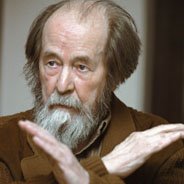
Solzhenitsyn Speaks


Aleksander Solzhenitsyn is one of the great heroes of our times, both for his principled stand against Soviet tyranny, and for his perceptive analysis of the totalitarian implications iherent in Communist ideology, so it is worth noting what he has to say about the current condition of the world.

In a recent interview Solzhenitsyn denounces the Gorbachev and Yeltsin regimes [so much admired in the West] for their failure to preserve the Russian nation. Under them Russia was dismembered and its assets plundered, leaving it a mere shell of its former self. "Saving the nation," he says, numerically, physically, and morally -- is the utmost task for the state. He gives at least tacit approval to the current Putin regime, despite its hostility to liberal democracy, because Putan, at least, is trying to address some of the nation's most pressing problems. All measures to raise living standards – housing, diet, healthcare, education, morality, etc. – are in effect designed to save the nation. This is an overriding priority.

Have you noticed, Solzhenitsyn is by no means a champion of liberal democracy on the western model. He is not a foe of democracy, but feels that the West is not an appropriate model on which to build it. Instead he argues that a true Russian democracy must rise in an organic manner from the ancient and local institutions of Russian society.
A healthy democratic system can only evolve on the grassroots level, from local associations, stepwise, through stage by stage elections. Only this setup can ensure that reasonable and general interests – industrial, professional, occupational, environmental, cultural, educational, etc. – will prevail. This is a very difficult path since it is full of bureaucratic obstacles on many levels. I believe that a democratic system evolving from local government to Supreme Legislative Assembly is the healthiest for Russia and the most consonant with its traditional spirit.
His admiration for the Enlightenment is tempered by its failings.
We have been hearing all this talk about “human rights” ever since the Enlightenment era; they have been secured in a number of countries, but not always within the bounds of moral values and principles. Yet for some reason no one has ever urged us to defend “human obligations.” Even calling for self-restraint is considered to be ludicrous and absurd. Meanwhile, only self-restraint, self-denial can guarantee a moral and reliable resolution of any conflicts.
And here we get to the core of his thought. The exalted principles of human rights and liberal democracy are silent on the matter of moral obligation. He is repulsed, as are billions around the globe, by the secularizing and demoralizing content of Western liberalism.

He looks instead to a restored "conservatism" that seeks to preserve and uphold the best, the most humane and reasonable traditions that have justified themselves throughout centuries-old history. This is not reaction, which is simply a response to current ills and "total license", but a recapturing of the ancient traditions of Russian culture, including, especially, its religious traditions.

And it is not just in Russia that there is a need to recapture the past. Speaking on a global scale he repudiates Huntington's concept of a "clash of civilizations," seeing instead a clash of rich vs. poor and resistance to the secularizing tendencies of modern Western culture.
A more accurate description of this world conflict would probably be this: The Third World vs. the Golden Billion. It has been caused by the global divide between the rich and poor. (Saudi Arabia and some other countries are not an exception here: They are only using the West’s run-away secularism as an easy target. This triumphant secularism in fact arouses the utmost indignation in the Muslim world.
So the real target of his concern is the "Golden Billion" inspired by a "triumphant secularism" and in the vanguard of this world-challenging force is the United States which has been using its military and economic power to expand Western liberal culture and economic into all parts of the world. This, Solzhenitsyn holds, is a real challenge to Russian integrity and must be resisted domestically, although he feels that in its present weakened state Russia is incapable of playing a significant part in the great conflicts of our day. He urges Russia to remain aloof from international controversies, taking no side in any dispute, and instead focusing all its efforts toward restoring its domestic integrity.

Very interesting, and an important dissent from the current enthusiasm in the West for promoting "human rights" globally and for liberalizing the world. Ultimately, he thinks, "total liberalism" had its day and is now "a spent force." Certainly it is provoking strong and persistent opposition both in the West and throughout the world. I wonder what Frank Fukuyana thinks of all this.

Read the whole thing here.

Friday, May 05, 2006

TNR on Darfur

The New Republic is devoting a whole issue to the ongoing genocide in Darfur. Lots of perceptive information and commentary there. The main point made by the editors, though, is that there is no point in complaining about something unless you are willing to do something about it. The swelling sympathy for the Darfur victims is just empty emotionalism unless real action is taken to stop the killing -- and, since the "international community" is once again incapable of action, it falls to the United States to do something.

What a pity that the irresponsible anti-war stance of the Democrats has paralyzed us.

Read the whole thing here.

Faugh!

The Heckling of Rummy

That guy, Ray McGovern, the "former CIA analyst," who stood up during Rumsfeld's a couple of days ago who was celebrated as a truth-teller in the MSM, on blogs, and on cable TV; remember?

Well, there's more to the story. The guy is a real fringe conspiracy nut.

Read about it here, and here.

What seems clear, as more and more of these creeps surface, is that the CIA has long been infested with, perhaps even dominated by, wild-eyed nut cases. Back before Dubya, this was the conventional wisdom -- these guys are nuts and dangerous ones. Since they have become Bush bashers, though, they are treated with respect in the MSM. But they are still a bunch of loons, as guys like McGovern are proving with every public utterance.

There have been several suggestions over the years that the CIA be abolished. Maybe it's time.

UPDATE:

Wretchard over at the Belmont Club has an extensive discussion of the exchange. Check it out here.

Andrew Sullivan at first reflexively defended Rummy's heckler. Now he's having second thoughts. He admits that in some respects McGovern is a "crazed lefty." [here]

Thursday, May 04, 2006

Pennsylvania Politics -- Santorum up, Swann down

The full results of the Keystone Poll are now out. It shows, as I reported yesterday, that Santorum has closed the gap to six points in his race against Casey. It also shows that Ed Rendell's TV advertising campaign has paid off. He has opened a 14 point led over challenger Lynn Swann.

Read the whole thing here.

Wednesday, May 03, 2006

The Continuing Collapse of Scientific Authority -- The Gatekeepers Fail

The New York Times finally recognizes that there is a crisis of authority in medical science.

Recent disclosures of fraudulent or flawed studies in medical and scientific journals have called into question as never before the merits of their peer-review system.

....

Virtually every major scientific and medical journal has been humbled recently by publishing findings that are later discredited....

[E]ven the system's most ardent supporters acknowledge that peer review does not eliminate mediocre and inferior papers and has never passed the very test for which it is used. Studies have found that journals publish findings based on sloppy statistics. If peer review were a drug, it would never be marketed, say critics, including journal editors.

....
A widespread belief among nonscientists is that journal editors and their reviewers check authors' research firsthand and even repeat the research. In fact, journal editors do not routinely examine authors' scientific notebooks. Instead, they rely on peer reviewers' criticisms, which are based on the information submitted by the authors.
....
Journals have devolved into information-laundering operations for the pharmaceutical industry, say Dr. Richard Smith, the former editor of BMJ, the British medical journal, and Dr. Richard Horton, the editor of The Lancet, also based in Britain.
Read the whole thing here.

My criticisms of this article are three:

1) It's far too little and too late. This scandal has been public knowledge for years now and has been widely reported elsewhere. Once again the Times has dropped the ball, largely because it has been unwilling to admit that one of the main institutional pillars of the scientific establishment is not, and has never been, what it claimed to be -- a guarantor of objective information and judgment.

2) The Times lays the blame for corrupting the system exclusively on corporate interests, and does not recognize that activist groups with political agendas are far more likely to produce corrupt studies which are widely publicized by an ignorant and biased press establishment.

3) The Times does not admit that the problem of fraud and error is just as pervasive, perhaps even more so, in environmental studies as in medicine.

The crisis of scientific authority is, in short, far broader and deeper than the Times is willing to admit.


Back In the Mountains

The Pink azaleas may be all, but the red ones are in full flower.

And the lilacs are just plain gorgeous.

And how 'bout them dogwoods. Cities are nice, and there's always a lot going on, but springtime in the Appalachians is special. So once again we retreat to our mountain fastness, or what "She Who Must Not Be Named" thinks of as the "fortress of solitude" [she's a city girl and after a few days misses the bustle].

Pennsylvania Politics -- Santorum Closing Gap

PoliticsPA is reporting that the soon to be released Keystone Poll shows that Rick Santorum has moved to within six points of Bob Casey in the Senatorial race 47% to 41%. Looks like things are starting to get interesting. Look for a "dump Casey" move among Dem liberals. It won't succeed, but it will give us lots of stuff to write about.

Read it here.

RELATED:

And the latest Rasmussen poll shows Swann leads Rendell by three points. No real change here. All the polls show this race as really close.
All four of polls on this race conducted in 2006 have found the candidates within three points of each other. Swann has ranged from 41% of the vote to 45% in the four polls, Rendell from 41% to 46%.
Read it here.

Sit Down and Shut Up -- Juan Cole Lashes Out

Juan Cole has never been a particularly stable individual, particularly in his internet forays. I lost all respect for him as a commentator and as a person when, in one of his periodic tirades, he accused two of his critics [Iraqi bloggers, Omar and Muhammed of Iraq the Model] of being "CIA plants." Not only was the accusation untrue and hurtful, it was dangerous. It could easily have cost the Baghdad bloggers their and their families' lives.

Repulsive and despicable behavior has not, however, impeded Cole's academic career. He is tenured at the University of Michigan and is currently being considered for a position at Yale. Recently Cole tangled with Christopher Hitchens on the subject of Iran. Michael Young, writing in Reason, summarizes the argument and gives an example of Cole's vituperative style:
So sit down and shut up, American Enterprise Institute, and Hudson Institute, and Washington Institute for Near East Poslicy [sic], and American Heritage Institute, and this institue [sic] and that institute, and cable "news", and government "spokesmen", and all the pundit-ferrets you pay millions to make business for the American military-industrial complex and Big Oil.
We don't give a rat's ass what Ahmadinejad thinks about European history or what pissant speech the little shit gives.
I call on university students across America to begin holding antiwar rallies. The only way you can have a war on Iran is to draft the young people. It is you who are on the line. Demonstrate! Demonstrate against the very hint of war! Demonstrate to end the one we've already got! (See Speaker's Forum on Iraq
Here is what the real Iran experts think about the prospect of an Iran war.
Because Hitchens's dirty tricks and lies against me are only the beginning. Whoever stands against the Perpetual War machine will be attacked, slimed, marginalized, and destroyed if the warmongers get their way. I don't care. Thus far and no farther.
One, two, three, four. We don't want your stinking war!
Yep..., he'll fit right in at Yale. Sad, but true.

Here's Hitch's Slate piece.

Here's Cole's response.

Here's Sully's take on the matter.

Read Young's piece here.

Hitchens discusses the contratemps with Hugh Hewitt here.

Peters on Globalization

In today's Post Ralph Peters makes an important observation regarding the effects of globalization. He writes:

Rather than making the masses feel connected (on the Internet or otherwise), the tempest of forces we lump together as "globalization" leave men and women around the world feeling threatened and disoriented. In consequence, they turn to what they trust: exclusive identities, local beliefs and fundamentalist religion.

The heralds of "ice-cream-sundae globalization" - the notion that trade, connectivity and converging tastes will lead the world to realize humanity's common interests - aren't at the cutting edge of thought. They're 30 years behind the times.

The golden age of globalization theory passed in the late 1960s and 1970s, when campus commissars insisted that tribes didn't exist and nationality was an artificial construct, that such "assigned identities" were imperial Europe's inventions, that humanity's true beacons of hope shone in Third-World dictatorships.

The intellectual porn of left-wing fantasies foresaw the defeat of capitalism and the rise of the new, liberated, post-national man. All that's left are Che Guevara t-shirts and the dead of Srebrenica, Cambodia, Rwanda and dozens of other tributes to human solidarity.

Yet the discredited intellectual conceits of that earlier generation of thinkers live on today in the sacred groves of academe where "transnationalism" is all the rage. And hte academics are merely following the lead of today's power elites.

What we "are witnessing isn't the convergence of the masses for a chorus of "We are the world," but the rise of a new, globe-spanning aristocracy...."

Just as yesteryear's aristos did, today's nobility of wealth and culture see themselves as above nationality. Patriotism is fodder for the peasants (unless it can be exploited for profit). They have far more in common with business partners across the globe than with the guy who fixes their plumbing. They intermarry across borders and forge alliances based on their own interests - as the Tudors, Valois and Medici did before them.

This new aristocracy is less attached to a passport than to a lifestyle. As for those who can't afford the price of admission, let 'em eat cake.

And what of the rest of the world's population?

Globalization as we know it has not encouraged a sense of common humanity among the masses - only a sense of common interests among the new aristocracy (with no sense of noblesse oblige). For the billions left outside the gated communities, globalization has excited fear and revived old hatreds: It's revelry for the rich, rivalry for the poor.

Even in our own society - the best-positioned in the world to profit from globalization - there's a worrisome divide between the multinational executive who retires with a $400 million farewell smooch (and who naturally supports globalizing trade), and the worker maxing out a credit card to pay for a tank of gas - to whom globalization means a threatened job, even if it also means cheaper underwear.

He concludes:

The point isn't that globalization is good or bad - it's both - but that it's vastly oversold when it comes to reforming human character and weakening group identities. Along with commercial integration, we get social fragmentation.

Read it here.

Gee, it's nice that he admitted, at the very end of his piece, that there might be some unspecified benefits from globalization, and that those benefits might accrue to people other than the transnational elite.

The economic effects of globalization are undeniable. Since WWII the standard of living of the world's population has risen dramatically, and not just in the West, due to the proliferation of global trade relations. Both the proportion and the absolute number of people living in abject poverty has been steadily declining, and that decline has accelerated in recent decades. The past few decades have seen throughout the world more available health services, better nutrition and access to potable water, better education and communication, and many other benefits of the spread of global interrelations and institutions. And, perhaps most surprisingly, since the end of the Cold War there has been a dramatic decline [yes, decline] in the incidence of both intra-state and inter-state conflict. The world is rapidly becoming a more peaceful place.

Still Col. Peters has a valid point. The cultural and psychological effects of globalization are not what they were predicted to be. The transnational elite has become a new aristocracy, exhibiting all of the vices and few of the virtues of traditional aristocracies. And few people outside that elite have been willing to adopt their shallow cosmopolitanism.

The rise of an elite radically disconnected from the population that sustains it is indeed a "worrisome" development, especially in places like the Middle East and Africa where it has become parasitic or predatory, but the general trend has been positive and, if we have not achieved the utopian condition predicted by the academic lotus-eaters of the sixties and seventies, we still have achieved much in a very short time.


Some Clarity on Stem Cells

The debate over government funding for stem-cell research has been characterized by hyperbole, misrepresentation and snark, nearly all of it emanating from the left which has tried to use the controversy to brand President Bush as being "anti-science" (which he most certainly is not).

For a sane discussion dispelling many of the untruths that have been raised in this debate, check out this piece from NPR [NPR!, balanced coverage! amazing!]

A couple of the assertions are worth noting:
If the federal government doesn't expand funding for embryonic stem cells, will U.S. scientists flee to other countries?

Probably not.

There is no evidence that this is happening.

....

Are U.S. scientists prohibited from doing certain kinds of embryonic stem-cell research?

No.

There are virtually no restrictions on the kind of stem-cell research that may be done in this country. The federal restrictions are on the use of federal dollars for embryonic stem-cell research. With private money, scientists can do practically anything they want.

Bet you didn't know that, did you? Certainly the Democrats and the NYT didn't tell you.

Read it here.

Monday, May 01, 2006

Interesting Development in Iran


This is potentially huge!

Cliff May notes that massive anti-government demonstrations took place in Iran today. Why weren't they reported in this country?

Read about it here.

Shelby Steele Gets It!


I met Shelby Steele several years ago when he was promoting his award-winning book of essays, The Content of Our Character, in which he urged African-Americans to live up to the ideals put forth by Martin Luther King in his great "I Have A Dream" speech. At the time I was immensely impressed both by the man and by his thought processes, and he has continued to rise in my estimation ever since.

Steele's latest book is White Guilt: How Blacks and Whites Together Destroyed the Promise of the Civil Rights Era. William Murchison reviews in in the Washington Times. He states Steele's central argument thusly:

In the context of the civil rights revolution, whites, to expiate their guilt for "centuries of oppression," vacated their moral authority, their power to differentiate right from wrong and act upon the distinction. When it came to race, whites weren't to "judge" any longer. Black "leaders," supported and egged on by the white cultural rebels of the 1960s and '70s, saw their chance and took it. All they had to do to get money, preferment or both was open their mouths and rub in the guilt.

"White guilt," says Shelby Steele, "had inadvertently opened up racism as the single greatest opportunity available to blacks from the mid-sixties on -- this for a people with no other ready source of capital with which to launch itself into greater freedom." It has come about that "We blacks always experience white guilt as an incentive, almost a command, to somehow exhibit racial woundedness and animus."
What Steele describes is a mechanism by which, with frightening rapidity, cultural standards of all kinds [not just those dealing with race] were abandoned -- what some have called the "demoralizing" of America and Pat Moynihan called "defining deviancy down." Outrage, woundedness and animus became the common currency of public discourse. We are living with the results of that process today and trying to recover from them.

And here is where President Bush comes in.

In the more broadly humane policies of the Bush administration, Mr. Steele sees some expiation for the idiocies of the past. Yes, Mr. Bush engages in dissociation. He talks the talk, appoints the blacks. But he gets it.

"His 'bigotry of low expectations' statement was the first and most far-reaching enunication of social policy" since the Great Society, writes Mr. Steele. "It offered a new direction for social reform and, especially, a new theory: dissociation from the racist past through principle and individual responsibility rather than at the expense of those things. Mr. Bush is the first conservative president to openly compete with the left in the arena of ideas around poverty, education, and race. He has attempted to establish conservatism as a philosophy of social reform."
Exactly!!!!!

Steele gets it. He understands that George W. Bush is one of the great ones -- a man of vision who challenges all of us to rise to new levels of endeavor and accomplishment, to take some responsibility for the state of the world and our society as it is and to try to do better. In both domestic and foreign affairs Bush has sketched out a vision of a better world and taken concrete steps to achieve it. This is why he is so much despised by the forces of reaction arrayed against him and this is why he is a far greater man than any of his critics.

Making [Girl]Friends in Eurabia


Der Spiegel reports:
It must have seemed like a good idea at the time. Europe's largest brothel, the Pascha in Cologne, which incidentally claims to be the world's only brothel with a money-back guarantee for dissatisfied customers, attached the flags of all 32 nations competing in the World Cup to its façade in a bid to demonstrate international flair and attract custom during the tournament this summer.

A giant poster covering the side of the seven-story, 126-apartment building showed a friendly-looking blonde woman lifting up her bra above the slogan "A Time to Make Girlfriends", in a play on the World Cup's official slogan "A Time to Make Friends." Right beneath her pink panties were posters of the flags, including those of strictly Islamic Saudi Arabia and Iran.

Pascha's manager Armin Lobscheid had also erected real flags of all the World Cup nations on another side of the building.

The campaign provoked excitement, but not the kind the management was hoping for. Men from the Muslim community came to the door complaining that showing the flags of Saudi Arabia and Iran was an insult to the Prophet Muhammad. Later, some returned in masks.

"On Friday evening we were threatened by 11 masked men who demand that we take down the Saudi Arabian flag," Lobscheid told the Kölner Express, a local newspaper. Not wanting any trouble, the brothel obliged and removed it and the Iranian one. But that still left the flags printed on the poster.

"On Saturday night there were 20 masked men armed with knives and sticks. They threatened to get violent and even bomb the place unless we black out the Iranian and Saudia Arabian flags on the poster as well," said Lobscheid.

The men had left before the police arrived. But to spare his establishment any more trouble, Lobscheid ordered a crane to black out the two flags as well.

Read it here.

Now explain to me just how are these Islamist thugs different from the Sturmabteilung [Nazi storm troopers -- the "brownshirts"]

Koln has always been one of my favorite cities, and when I was young I spent a lot of time there. But that was a long time ago and things sure have changed, in a lot of ways.

And in a related development:

WASHINGTON, May 1, 2006 (LifeSiteNews.com) - The woes of legalized prostitution in Germany are about to be felt by the world. With the World Cup soccer tournament to be held in Berlin beginning June 9, an estimated three million fans are expected to flood the city. The German government and local governments are preparing for an increase in sex-traffic and the resulting tax revenues by aiding the construction of huge brothels. A four-story brothel, the largest in Germany, opened late last year a short distance from one of the main venues of the World Cup.

As many as 40,000 additional women are expected to be added to the approximately 400,000 prostitutes in Germany's sex industry. German authorities are rushing to accommodate the trade in women by facilitating the construction of mega-brothels and "sex huts." Moreover, cities hosting the games will issue special permits for street prostitution, creating a virtual partnership with brothel owners, pimps and traffickers.

Read it here.

As I said before -- things really have changed in the Fatherland.

Weekend at the Harbor -- The Aftermath

The crowds are gone, the boats are back in their berths preparing for the next stage of their race around the globe. The Cisne Branco is preparing to depart, to be replaced by the Dutch ship, Stad Amsterdam. And so as the sun sinks slowly in the West we bid adieu to the lovely Inner Harbor and its exotic inhabitants, and make plans to head back to our mountain lair. As for the rest...,

Get ready New York, the cats are coming.

Weekend at the Harbor, Part 9 -- Heading Home


More cats terrorizing small craft [I can't help it, I like them] and let's not forget the corporate sponsors who underwrote the whole thing.

Weekend at the Harbor, Part 8 -- Who Let the Cats Out?


It was getting downright crowded at the harbor. And the cats finally left their cages. For most of the afternoon they stunted around nimbly dodging slower traffic. "She Who Must Not Be Named" was particularly impressed to see them from time to time catch the wind just right and heel over to coast along on one pontoon. I kept waiting for one of them to go all the way over, but they never did.

Weekend at the Harbor, Part 7 -- Entertainment


And there were marching bands, and pub bands, and street performers, an excellent jazz concert, and (this being the U.S.) cooking demonstrations and a competitive eating contest, won by a 90 pound woman who styles herself the "Black Widow." Why is it always the little guys who win these things? You could spend the entire day wandering around, meeting up with friends, eating and drinking, being entertained and listening to an amazing range of music. In fact, that's what I did.

Weekend at the Harbor, Part 6 -- The Peeps Come


All day long, crowds surged through the harbor area. The official weekend estimate was half a million attendees.

Weekend at the Harbor, Part 5 -- Star Treatment


Here they are, tucked in for the night and early Sunday morning.

Weekend at the Harbor, Part 4 -- Here Come the Stars


This is what everyone came to see, the Volvo Ocean Racers. These boats just finished the Rio to Baltimore leg of their round the world race and are resting up here and in New York before the last dash across the Atlantic to Liverpool.

Weekend at the Harbor, Part 3 -- The Tall Ships


Tall ships don't usually associate with the little guys, but they like to hang with the Constellation.

Weekend at the Harbor, Part 2 -- Cats and Another Dragon


Here's a better picture of one of the dragon boats, and the cats, berthed and waiting to prowl.

Weekend at the Harbor, Part I -- Tall Ships and Dragons


It was a grand weekend at the Harbor. There were tall ships, small ships, cats and dragons, and all manner of watercraft. The Volvo Ocean Race boats were in town and the celebration was built around them. The tall ship pictured is the Cisne Branco from Brazil. When I referred to "dragons" I didn't mean the paddleboats in the foreground, but to the long, low craft behind them. That's a "dragon boat" and in September the Harbor will be hosting a major race among several crews. Saturday they were just practicing.

More later....