Day By Day

Wednesday, August 24, 2005

Baghdad Blogger -- Salam Pax on TV


Link Network is broadcasting "Baghdad Blogger" starring Salam Pax. This episode runs from 11:00-12:30 EST and will be rebroadcast from 5:00-6:30 tomorrow morning. It's fascinating -- a tour of Sadr City during last year's uprising, a feature on the Iraqi Symphony as a symbol of national unity, and much, much more. Definitely worth taping.

LINK is definitely a good alternative to the standard news channels. It broadcasts a lot of lefty/pacifica stuff, but there are real nuggets here and there. Salam Pax is one of them.

Here's the network's website. Salam Pax's page is here. Here's a Guardian story on him.

Tuesday, August 23, 2005

Ledeen Likes the Iraqi Constitution [sorta]

Michael ["Faster, faster"] Ledeen points out that on the subjects of Sharia and federalism Iraq's constitution is much more progressive than others in the region. He generally approves [but wants to see the final product].

Read it here.

ALSO FROM THE CORNER:

Rich Lowrey writes that he has been talking to people who say that a deal is in the works. The de-Baathification provision will be dropped [to be handled legislatively later] and the bar for regional autonomy will be raised. Apparently this will satisfy some of the Sunnis. Here's hoping so. I've been arguing that particularly issues need not be written into the constitution and would more appropriately be handled through legislative action over time. If Lowry is right, then at least some of the Iraqi leaders agree.

Lowry's comments here [and also scroll up].

Natalie Portman -- Policy Wonk/Movie Star


Who'da thunk?

You get so used to vacuous utterances from movie stars that it is a pleasant surprise to find one who can hold his/her own in serious intellectual discourse. One such is Danica McKellar from The Wonder Years, who is also an accomplished mathematician [read about her here]. Another is Natalie Portman [yes, Queen Amidalia, who has uttered some of the stupidest lines ever, but that's Lucas' fault, not hers]. Portman, born in Jerusalem [her real last name is Hershlag], speaks five languages, has a Harvard degree, refuses to do films that she feels do not have a positive message, doesn't smoke, drink, or do drugs, has been a major star since age 12, and is [according to Fareed Zakaria, who has interviewed her on the subject] a well-informed and competent expert on micro-financing in developing nations. And, on top of all that, she's a vegan and she and Britney Spears are buds.

On Portman's wonkery see this article in Newsweek International. For biographical info see here.

I am reminded that Robert Vaughan ["The Man from Uncle"] holds a Ph. D. [his dissertation was on McCarthyism in Hollywood] and that David Duchovney ["Fox Muldar"] is a Princeton ABD.

What Kind of Constitution? David Mack

David Mack, speaking on FOX News, makes an important point regarding Iraq's constitutional process. He suggests that the best way to measure success is not whether the resulting document conforms to Western liberal ideals, but whether it provides a framework within which Iraqis can heal the enormous divisions that plague their nation.

Steven Vincent's Widow Slams Juan Cole

The Despicable Dr. Cole gets taken down a few pegs over at Iraqi Bloggers Central. Check it out here [it's not pretty].

So Does Iraq Have A Constitution or Not?

Well, sorta.

The Committee charged with drafting a constitution presented it to the Interim Assembly yesterday, just minutes before the time limit ran out, but because of Sunni intransigence the Assembly delayed voting on the document for three days. So, the constitution has been presented, but not yet adopted.

What to make of this situation?

The LA Times gives some indication of what the draft contains:
People who have viewed the document said it includes vague language weakening Iraq's strong central government, enshrining a federalist system, and addressing how oil revenue is to be split between Baghdad and the provinces.

The text calls for such liberties as freedom of expression and the press. It gives Islam a role in national affairs, while offering Iraqis the option of following civil code in areas such as marriage, divorce and inheritance.

But the drafting committee left it up to the transitional National Assembly to sort out issues including specifics on regional rights, the language of the preamble, the removal of Saddam Hussein's former Baath Party members from government, and the exact role of the presidency, officials said.
Read it here.

This pretty much agrees with other reports coming out of Baghdad and represents considerable progress. The vagueness should not be a problem, but probably will be. The American constitution, you will remember, was deliberately vague on a number of matters upon which no consensus or compromise could be reached at the convention. These included slavery and the makeup of the federal judiciary, the relationship of states to the federal authority, definitions of citizenship and the rights attached to it, and a host of other touchy issues, all of which had to be worked out over time through the political process, and for that matter are still being worked out today.

All that a constitution really needs to do initially is to define a structure and procedures within which political controversy can be accommodated. If other provisions prove to be necessary they can be added through an amendment process. Other arrangements can be reached through something less than a constitutional provision. The entire structure of America's federal judiciary, for instance, was defined and redefined through acts of Congress, not in the constitution itself. Yet all sides seem to be wedded to the insane proposal that a constitution must set out in advance definitive answers to any question that can be raised. This is European lunacy and the US should never have bought into it.

If the Iraqis are smart they will adopt a constitution while leaving seemingly intransigent issues unresolved to be addressed through the normal political process and possibly through amendment. The committee has done its job and has presented a basic draft. This can be amended through wider debate in the whole assembly, and further amendment can come as a result of a true national debate during the weeks and months leading up to ratification. That's the way it was done in the US. The Bill of Rights was added to the federal constitution after it had already been ratified and the need for such protections had arisen out of the ratification debates that had taken place all across the country.

The pursuit of consensus is a recipe for disaster. At this time and in this way it cannot be achieved. So the best we can do is to accept an incomplete constitution and allow the normal, non-constitutional process to work out over time solutions to those problems that are now too intractible to be resolved.

I suspect that the problem is that there are too many damned lawyers involved in the process. They think that in the normal course of things basic decisions should be reached through judicial rather than political processes and therefore want as comprehensive a fundamental law as possible. We've already taken a lot of chances in our Iraq adventure -- why not take a chance on the politicians?

Northern Ireland -- The Troubles Never End

The New Republic runs an article by Ron DePasquale arguing that despite the recent spate of good news from Northern Ireland optimism about the future is not warranted. He writes:

[O]ptimism is misplaced. Yes, the IRA's long war is over, and the number of British troops in Northern Ireland will be cut to the lowest level since the conflict erupted in 1969. Ulster, however, remains far from normal and stable. Protestant unionists don't believe the IRA will disarm, now or ever, and are threatening to boycott the peace process in protest of the British demilitarization plans. Ian Paisley, the fiery preacher who leads the hard-line Democratic Unionists, refuses to negotiate with Sinn Fein and has called Adams a "terrorist."

It is clear that the Good Friday Agreement--which created a Northern Ireland government in which Catholics and Protestants would share power and which the world assumed had finally solved the Ulster problem--has failed, in part because each side believed that the agreement meant something other than it did. With the increasingly powerful hard-line parties deadlocked, the middle ground has disintegrated. And, as a result, Northern Ireland's Protestants and Catholics are further apart today than ever....

[E]ven if the IRA does finally disarm, the British will need to keep running a feverishly polarized statelet that, left to its own vengeful politicians, would be completely dysfunctional.

Northern Ireland's voters have not only supported hard-line parties in growing numbers, helping to create a political stalemate, but physical and cultural divisions between the two sides have hardened, too. Voluntary segregation has continued, as Protestants cluster along the eastern coast, leaving the western backcountry to Catholics. Belfast and Londonderry residents still move across town to live among their own. The price of peace, paradoxically, is a divided province, enflamed by the same ancient tribal passions that led to the decades of bloody strife known as "the Troubles."

Read the whole thing here [subscription required].


Condi, Condi, Condi


Condi is looking great. In fact she stacks up pretty well against la Angelina [reputedly the "sexiest woman in the world"]. Toby, the Bilious Young Fogey, notes that Condi is polling really well in Iowa but that she still hasn't impressed that nasty old hater, Harry Belafonte. "She Who Shall Not Be Named" tells me that Condi, or someone on her staff, has amazing clothes sense. Being a guy I hadn't really noticed, but I'll take her word for it.

Monday, August 22, 2005

Iraq -- The Psychological Effects of Terror

The Neurotic Iraqi Wife has given up on democratic reform. She writes:
I dont like being here, in fact I cant stand it anymore. These words are very difficult to utter even to myself cuz its a sign of weakness, its a sign of hopelessness, but it is the truth and the only truth that I came to realize. Im disappointed in myself for feeling that way but there you go I ve said it.

Now all I can think about is going away, leaving, packing my bags and never coming back. But Im afraid, Im afraid if I do that I will lose my HUBBY, lose him for good. I had hopes and dreams when I came here, I had a different picture in my mind and Im really disappointed and disgusted at the same time. HUBBY and I lost someone we got to know. Someone extremely kind, extremely funny, extremely spiritual. I cant say more about how we lost him for he aint found yet, and theres that little tiny voice that says keep the faith, he might be still here, breathing the same air, looking at the same stars. But the news came as huge shock to all of us and somehow changed something deep inside.

I ve lost hope in the future of Iraq. I know many of you will find this distrubing but this is generally my own views and what I came to realize by being here. Im sorry, but the free democratic Iraq we all are hoping for wont take place, not now, not in 5 years not even in 10 years unless we get a real government who cares sincerely about the Iraqi people. Iraq needs someone who is honest yet firm, someone who is caring, yet strong. Someone who really is serious in building a country and reviving the people.

People here have no faith in anyone anymore. All the dreams they had during the elections have evaporated, all the hopes have gone and now they live their day just to survive the moment. Some people might think Im painting a very dark picture, Im sorry, but the picture I see from where Im at is dark, extremely dark. Yes you see schools being rehabilitated, yes you see hospitals getting renovated , yes you see construction taking place, bridges, roads, airports, but what does all this mean if people cant enjoy what they see. What do newly painted schools mean, when children get kidnapped???

What does this whole reconstruction mean when you cant even go out and enjoy it. I look at peoples eyes and theres no lustre, its filled with sadness and hopelessness, even me, when I used to see that before, I would try to make them feel better by saying things will change, just give it time, now I dont even dare say these words, for I dont believe in them myself. And whoever says things will change is a dreamer. People are still living in dire circumstances. Electricity is barely there, do you know how that feels when you are in this scorching heat??? Water is not continious. Corruption is everywhere. What kind of a life is this??? Yet Im amazed at how Iraqis are so resilient, they really are survivors, they really have the spirit of Life.
This is the toll that terrorism takes on a population -- the insidious deterioration of hope, the rising tide of despair. What is disturbing is her hope for the emergence of a strong man -- someone who can bring order to Iraq, and that kind of submissive hope is antithetical to the democratic process.

Read her blog here.

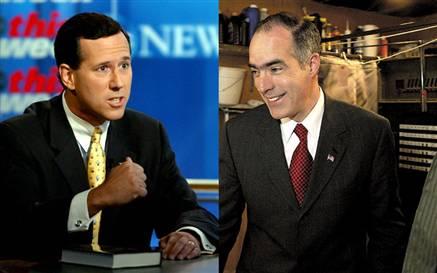
Pennsylvania Politics -- The Emerging CW


Howard Fineman, as always the repository of conventional wisdom, takes a look at the Pennsylvania Senate race between Rickey Santorum and Junior Casey. In particular he tries to figure out how the Iraq war will play in Pa. His conclusion -- well, he really doesn't have one [typical Howard], still it's worth checking out here.

RELATED:

AP has a nice overview of the Casey-Santorum race by Kimberly Hefling. In it she makes several interesting points that reflect themes that will be tried out over the coming months:

1) Casey has raised a LOT of money, but Santorum has more.

2) Casey’s pro-life stand undercuts some of Santorum’s appeal.

3) Both national parties are gearing up big time for this one.

4) Liberals, really, really, REALLY hate Santorum; he offends them on some basic level.

5) Democrats are trying out the line that Santorum is really interested in running for President and won’t serve out his term [that’s a laugher].

6) Santorum is emphasizing his consistency and principled stands, and ability to deliver for Pennsylvania due to his seniority.

7) Casey is running as a Washington outsider and denounces the poison partisanship that prevails within the beltway, much of which he blames on Santorum.

8) Democrats charge that Santorum is arrogant, but Casey is a nice guy.

9) General opinion is that Santorum is a lot smarter than Casey and therefore unlike most incumbents Rickey will seek debate opportunities that will give him a chance to demonstrate his opponents lack of mental acuity.

Like I said – this race is gonna be fun! Down and Dirty.

Read it here.

Zimbabwe Update -- Film at Eleven

Gateway Pundit has links to a film of the ongoing destruction being perpetrated by Mugabe's thugs in Zimbabwe. Check it out here.

Are Attitudes on Homosexuality Really Shifting?

Eugene Volokh applies some rough and elementary cohort analysis to poll results on the question of whether homosexuality is acceptable and comes up with some interesting points.

Within specific cohorts there has not been much change over time regarding the acceptance of homosexuality. However, cohorts born after the "sexual revolution" of the sixties are far more accepting than those born before. This suggests that gay activism over the course of the past few decades has had almost no effect on public attitudes, but that the sexual revolution did mark a major divide. Verrry Interrrrresting!

Read the analysis here.

James Taranto over at the WSJ reviews Volokh's work and makes the, to me rather far-fetched, argument that in fact public attitudes are changing, but that liberal gains on homosexuality are countered by the "roe effect" [liberal women having abortions and as a result fewer liberal kids are entering the population].

Read Taranto's piece here.

Down to the Wire Again -- The Iraqi Constitution

So where do we stand going into the last day of negotiations?

1) The Kurds have abandoned their demand for a constitutional "right of self-determination."

2) A compromise has been reached on the role of Sharia law -- it will be "a" source of legal authority, not "the" source.

3) That leaves the question of federalism and that boils down to finding an acceptable formula for the division of oil revenues.

So, in the end, it's all about oil after all.

A possible solution that is being advanced is to have the central government control the disbursement of oil revenues. Negotiators are hopeful that this will be acceptable.

The Kurds and Shiites, who account for about 70% of Iraq's population are reportedly on board for a compromise document, but the sticking point is the Sunnis. Together the Kurds and Shiites have enough representatives in the national assembly to pass a draft constitution, but a provision of the law would give the Sunnis a veto on ratification during the national referendum. And, as recently as yesterday, Sunni representatives were saying that they would not compromise on anything.

If an agreement can be reached -- well and good, but if not the assembly will have to choose between dissolution and voting another extension, at which point the whole exercise will have become a joke.

Read about it here, here, and here.

This is it guys -- time to sink or swim.

Stay tuned....

UPDATE:

The LA Times and AP are reporting:

Political groups representing Iraq's minority Sunni Arabs called yesterday for new delays in approving a national constitution, complaining that they had been cut out of final-hour negotiations between Shiite Muslims and Kurds and appealing to U.S. and U.N. officials to intervene.

Read it here.

Just what these groups are, and how much influence they have, is not yet clear -- and the appeal to the US and UN to intervene sorta contradicts the whole idea of the constitution.

UPDATE:

Omar at Iraq the Model, noting the large numbers of people, particularly Sunnis, registering to vote in the ratification referendum, writes:
It seems that everyone is getting ready to say their word the on constitution and all that is missing now is, er...the constitution!
Indeed!

UPDATE:

It's down to the closing minutes and still no agreement -- it seems that the Assembly will have to make a choice -- to extend for another week, to dissolve, or to adopt a partial document that leaves the essential questions hanging.

One thing seems clear -- if a document does emerge, it will not conform to US hopes going in to the process [and that, I would argue, is a good thing -- this is, after all, a constitution for Iraq, not for the US].

Stay tuned...

UPDATE:

Half an hour to go. The Shia and Kurds say they have a document ready to send to the Assembly. Sunnis say there will be another extension. Everybody's playing chicken. Who will blink?

Stay tuned.

UPDATE:

Fifteen minutes to go -- lots of smiles and handshakes. The Committee says that they have a draft ready to go. It seems that they have kicked the can down the road on some major issues -- but that is a good thing. The committee's work is done -- now the public debate can start, and that is the important one. "Federal, Democratic, Republican, Parliamentary" system is the term of the hour. Interesting. I don't see how all that fits together but am anxious to find out.

Stay tuned....

UPDATE:

They are announcing the draft. It has been submitted to the assembly. But there are problems to be worked out "over the next three days." So they have a basic document and the assembly will adopt an election law and there will be discussions over the next three days on amendments to be offered. There are three issues outstanding -- federalism, "de-Baathification" [not much commentary about that, but to the Baathists who stand to be indicted for crimes against humanity it is a HUGE issue], and how oil revenues will be distributed. These are big items, but they are resolvable.

The committee has finished its business. The assembly will now try to forge compromise amendments. Then there will be a final vote on the amended constitution and then we go to a referendum.

This is exciting stuff. A new kind of state is emerging before our eyes, and increasingly it is one crafted by the Iraqis themselves with minimal intrusion from the West. We have always hoped that Iraq would become the model for reform throughout the region -- today they took a big step toward making that a reality.

Stay tuned.

UPDATE:

Reuters is upset:

The new draft constitution contains the terminology "Islam is a main source for legislation and it is not permitted to legislate anything that conflicts with the fixed principles of its rules."

This offends secular liberals who see it as a threat to women's rights. But just how it is to work out is going to be determined in the future. For now, it recognizes other sources of law than Sharia, and it is quite vague as to what the "fixed principles" of Islamic law really are. It also does not mandate a clerical presence in the courts. So it really is a compromise, one that allows enough flexibility so that arrangements can be made down the road that all parties can live with, and that's what this exercise in constitution making is all about.

Read Reuters' story here.

RELATED:

For those who need a scorecard [and who doesn't?] WaPo has a nice article by Jefferson Morley explaining the Iraqi constitutional process and all its convolutions.

Read it here.

And, while we're here, a few comments about "deBaathification" which was specifically stated to be a sticking point by the committee, but which has been unremarked by any of the major media. The point here is that we are dealing with a tribal society here. For a generation and more a few favored clans held most of the political authority, and during that time many of them did very bad things, but now they have been displaced and their leaders are fighting literally for their lives. There is strong pressure from their victims and from international agencies to hold these people responsible for "crimes against humanity" and to bring retribution on them. These tribes will not surrender former Baathists, who are after all clan leaders, willingly to judgment. This is a major source of support for the insurgency. The demand, apparently, from many Sunni leaders, is that some provision be written into the new constitution protecting the persons and the rights of former Baathists. Perhaps demands for justice will have to be undercut in order to establish order. This is an uncomfortable subject, and I can see why the MSM and diplomats are desperate to avoid discussing it.
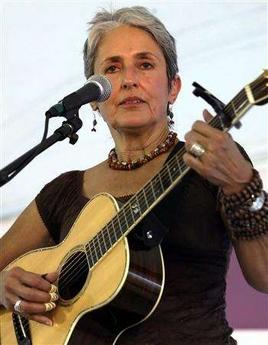
A Blast From the Past -- Joan Baez In Crawford


I suppose it was only a matter of time before Joan Baez showed up at the ongoing protests near Bush's "ranch." Another oldie moldy checking in. This is a great opportunity for creaky old flower children -- a chance to relive the most exciting time of their lives. Who can blame them?

So, what effect is she having?

AP notes that the free concert she is offering is expected to draw -- hold onto your hats for this one -- more than one thousand people!!!

Sorta sad, don't you think?

Read about it here.

Florida Politics -- Katherine Harris Just Keeps Rolling

The Pensacola News Journal reports:

Joe Scarborough is leaving the job of trying to unseat U.S. Sen. Bill Nelson to another Republican.

On Saturday, the former congressman from Pensacola ended several days of speculation by announcing he would not challenge U.S. Rep. Katherine Harris for the Republican nomination in the 2006 Senate race.

Jeb and the Republican national leadership are running out of options. They're going to have to swing their support behind Katherine sooner or later -- sooner would be better.

Read it here.

Pennsylvania Politics -- Casey's Opening Salvo

For months now, while Ricky Santorum has been flailing and falling in the polls, "Junior" Casey has kept mum. Now, with Santorum temporarily out of the national spotlight, Casey has opened up his first line of attack.

The Inky [that's the Philadelphia Inquirer for you out-of-staters] reports:

U.S. Sen. Rick Santorum's leading Democratic opponent, state Treasurer Robert P. Casey Jr., accused the senator this week of remaining silent while the U.S. death toll in Iraq rises.

After months of maintaining a low profile, Casey said the Republican senator was being too focused on "partisanship and ideology" to go after President Bush with the fervor he showed during the 1999 U.S.-led raids of Kosovo under President Bill Clinton.

So Bobby is hoping to ride an anti-war surge in opinion polls for a while. The charge that Santorum has a double standard -- a greater willingness to criticize Democrats than Republicans -- isn't meaningful. As one political analyst put it,
"That is a politician calling another politician a politician".
Read the article here.

What we have here is a series of exploratory jabs, testing the political climate to see what the public response will be. The campaign hasn't really begun in earnest and, depending on what happens in Iraq, the anti-war theme might become important or be dropped entirely.

Santorum is in a bind. To a great extent his fortunes in the coming election depend on how Bush does in the next year, and Bush isn't running for anything and therefore has little incentive to trim his actions to suit political purposes.

The game is just getting started -- it's gonna be fun!

Stay tuned....

Shifting Attitudes in the Muslim World

Michael Barone looks at the latest Pew Global Attitudes Project Report on popular opinion in the Muslim World and see's much to feel good about.

First:
support for terrorism in defense of Islam has "declined dramatically," in the Pew report's words, in Muslim countries, except in Jordan (which has a Palestinian majority) and Turkey, where support has remained a low 14 percent.
And:
Support for suicide bombings against Americans in Iraq has also declined. The percentage reporting some confidence in Osama bin Laden is now under 10 percent in Lebanon and Turkey and has fallen sharply in Indonesia.
And:
when asked whether democracy was a western way of doing things or could work well in their own country, between 77 and 83 percent in Lebanon, Morocco, Jordan, and Indonesia say it could work in their country--in each case a significant increase from earlier surveys.
Thus, even as support in the US for the war effort is waning, attitudes in the Muslim world are shifting in our favor. The ongoing terror campaign seems to be turning off Muslims just as much as it alarms Americans.

A real sea-change is taking place in Muslim attitudes.

Muslims around the world cannot help but notice that Iraq is moving, however imperfectly, toward representative government. They can't have missed the "Cedar Revolution" in Lebanon and the expulsion of Syrian forces from Beirut. They may have noticed the small concessions to democracy in Saudi Arabia.

New stakeholders. They may also have noticed that Egypt will have its first contested election for president this year. "There were no arguments over the United States, Israel, Palestine, Iraq, or any of the other 'hot spots' that used to dominate every meal and spill over into tea, coffee, and dessert," writes Mona Eltahawy in the Washington Post of her trip to Egypt this summer. "This time, all conversations were about a small but active opposition movement in Egypt that since December has focused on ending the dictatorship of President Hosni Mubarak. I have never heard so many relatives and friends take such an interest in Egyptian politics or--more important--feel that they had a stake in them." Minds are indeed changing.

And that, ultimately, is why we are in Iraq. Barone wisely observes:
[W]e are not engaged in a popularity contest. We're trying to construct a safer world. We are in the long run better off if Muslims around the world turn away from terrorism and move toward democracy, even if we don't like some of the internal policies they choose and even if they don't have much affection for the United States.
Well said! Much of the commentary surrounding the Iraqi constitutional process consists of worrying that the Iraqis will produce something less than full Western liberalism, that women's rights might be circumscribed, that there would be no wall of separation between religious and state authority, etc. But such concerns, while certainly important, are of less significance than the fact that Iraqis througout the nation and of all conditions will be taking part in the making of their own government.

Read Barone's piece here.
On the importance of political participation see here.

Zimbabwe Update -- Amnesty International Checks In

As if it mattered...,

Amnesty International has denounced Mugabe's population relocation campaign as part of a widespread program of human rights abuses stretching over many years.

Well, that will certainly make a difference.

Read it here.

Faugh!

Sunday, August 21, 2005

"The Blog is Hungry. The Blog Will Not Be Ignored" -- Achenbach on Bloggery


Joel Achenbach writes about his love/hate relationship with his blog.
The blog is hungry. The blog will not be ignored. It is an insatiable little beast, a creature still unclassified by science -- hairy, warty, slobbering, with its own fiendish agenda. I often fantasize about killing the blog, but I worry that it will respond just like the crazed computer in "2001: A Space Odyssey": It will try to kill me first.
Any of us who blog regularly know exactly what he's talking about.

Read the whole thing here.

Cartoon from Richard Thompson, WaPo.

Saturday, August 20, 2005

Catholic Babes in Cologne


Publius has pictures of babes from the Catholic World Festival of Youth in Cologne, Germany. And as a bonus you get pics of the Holy Father and the Koln Cathedral. Check them out here.